
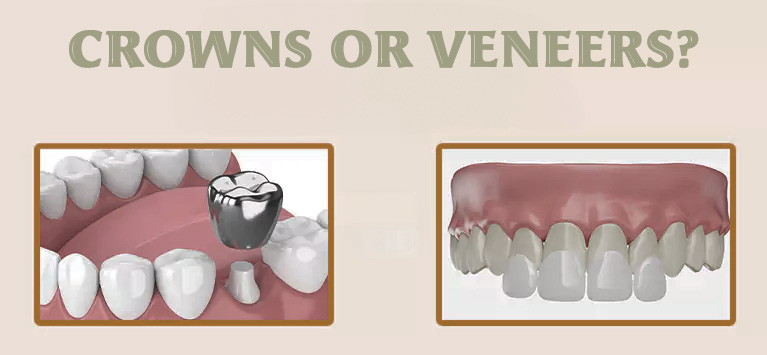
Crowns or veneers? Here is the short answer. If your tooth is basically healthy and the problem is how it looks, you want dental veneers. If the tooth is broken, heavily filled, root treated or carrying real chewing load, you want a dental crown. Veneers cover the front surface and remove 0.3 to 0.7 mm of enamel. Crowns cover the whole tooth and remove 1 to 2 mm. That one difference decides everything else: how natural the result looks, how long it lasts, and how much of your own tooth you keep.
We place dental crowns and dental veneers every week at our clinic in Antalya. The honest answer we give our own patients is that the better treatment is nearly always the one that removes less tooth, because enamel never grows back. Here is how we decide, and how you can decide with us.
| Dental crown | Dental veneer | |
|---|---|---|
| Covers | The whole tooth | The front surface only |
| Enamel removed | 1 to 2 mm | 0.3 to 0.7 mm |
| Best for | Damaged, weak or back teeth | Healthy front teeth, appearance only |
| Average lifespan | Around 20 years | Around 15 years |
| Most natural look | Very good with e-max or zirconia | Best, especially laminate veneers |
| Reversible | No | No |
What are dental crowns and dental veneers?
What is a dental crown?
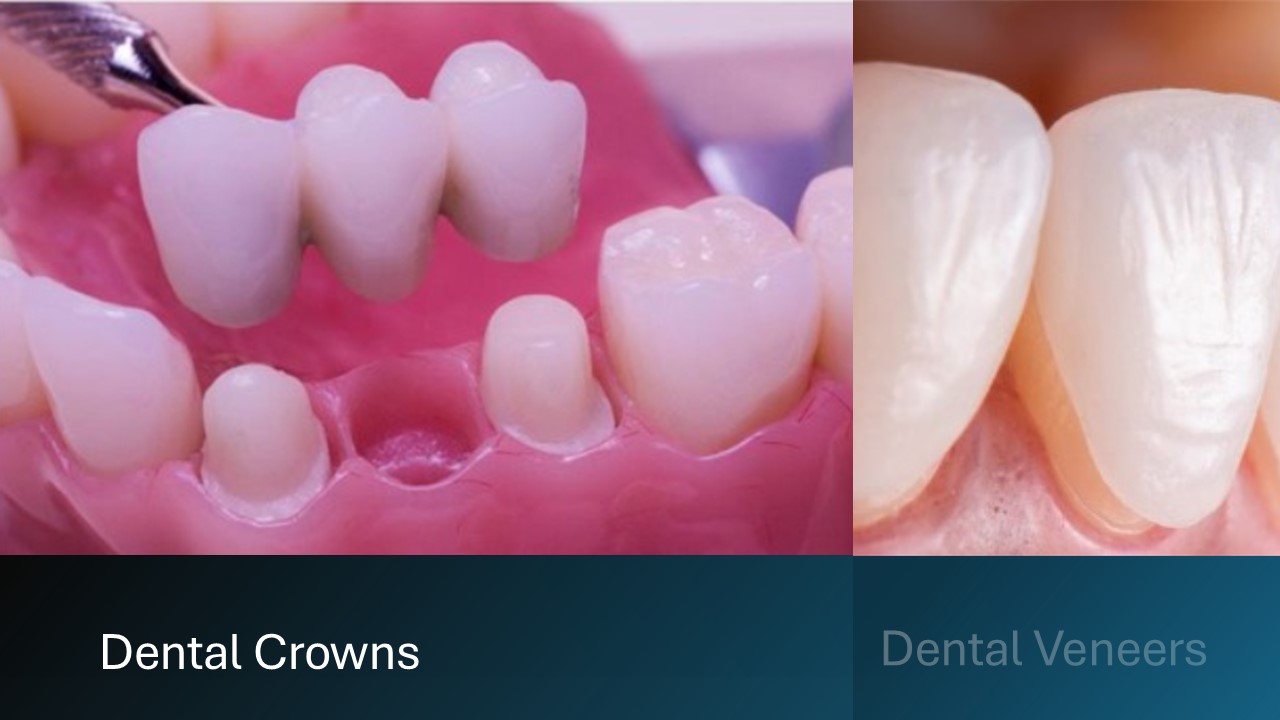
Dental crowns are caps that cover the whole tooth. A crown grips the tooth from five directions, the biting surface and all four sides, which is why it holds up to years of chewing and biting. Think of it as a new outer shell for a tooth that can no longer protect itself.
We use a dental crown when the tooth itself needs protecting, not just improving:
- Severely damaged teeth. Major fracture, decay or wear, where the tooth needs its strength rebuilt as well as its appearance.
- Large cavities and big old fillings. Once a filling takes up most of the tooth, the remaining walls flex and eventually crack. A crown holds them together.
- Broken or cracked teeth. Trauma damages the enamel deep into the tooth, and a crown seals and protects what is left.
- Teeth after root canal treatment. A tooth goes brittle after root canal treatment, so we crown it to stop it splitting later.
- Heavy wear and acid erosion. Grinding, clenching (bruxism) and acid erosion flatten teeth. Crowns rebuild both the height and the bite.
What is a dental veneer?
Dental veneers are thin porcelain shells bonded to the front of the tooth. We remove only 0.3 to 0.7 mm of enamel, and because the veneer wraps slightly around the sides it grips far better than most people expect. Veneers are an aesthetic treatment: they change colour, shape, size and length, and they leave the rest of the tooth untouched.
Situations where veneers are preferred
Veneers suit teeth that are sound underneath and simply do not look the way you want:
- Discoloured teeth that whitening cannot fix
- Worn, chipped or slightly broken front teeth
- Teeth that are the wrong shape or too short
- Gaps between the front teeth
- Mild crowding or slight misalignment
Patients not suitable for veneers
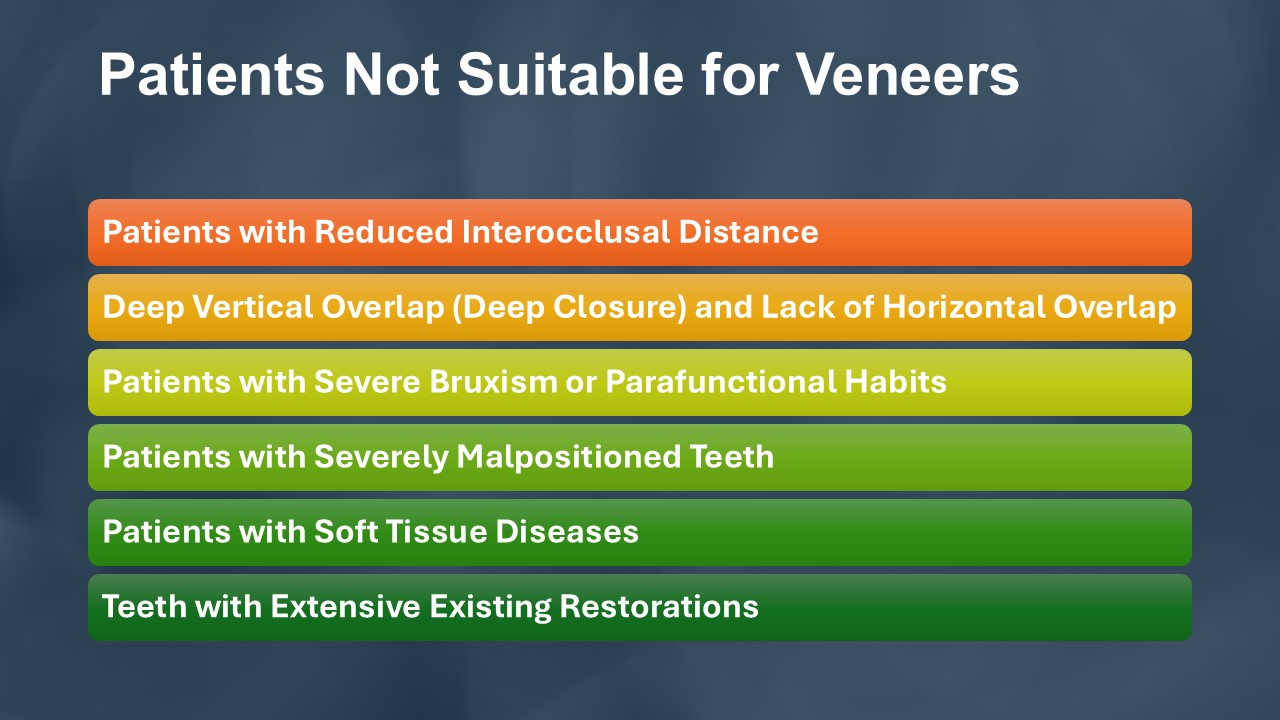
Veneers are not right for everyone. These are the situations where we will tell you so at the examination, and recommend something else:
- Not enough space between the teeth. When the vertical gap (interocclusal distance) is too small, there is nowhere for the veneer to sit.
- A deep bite with no horizontal overlap. If the upper front teeth cover the lower ones deeply, the veneer takes the full force every time you close, and it will not last.
- Heavy grinding or clenching. Bruxism cracks veneers. We treat the grinding first, and you will need a night guard afterwards either way.
- Badly crooked or crowded teeth. Veneers cannot straighten teeth, they only mask them. Orthodontic treatment comes first.
- Active gum problems. We never bond veneers over active gum disease or periodontal disease. That gets treated first, without exception.
- Teeth already full of fillings. If there is little sound tooth left to bond to, a crown is the safer choice.
Key differences between dental crowns and dental veneers
Six things actually separate the two treatments.
Application process
The appointments look similar. The difference is how much tooth we shape. For a crown we prepare every surface and remove 1 to 2 mm. For a veneer we touch only the front and the sides, and remove 0.3 to 0.7 mm.
This matters more than it sounds. Tooth enamel is only about 2.5 mm thick and none of this grows back. Prepare too aggressively and you expose the dentine underneath, which can lead to sensitivity, root canal treatment, and in the worst case losing the tooth. This is exactly why we push you towards the option that removes less, even when the other one earns us more.
Aesthetic outcomes
Veneers win on appearance in the smile line. Because porcelain veneers, and laminate veneers in particular, are thin, light passes through them the way it passes through natural enamel. Crowns can look superb too, and modern e-max and zirconia materials have closed most of the gap, but a dental crown covers the whole tooth so matching it to its neighbours asks more of the laboratory.
Durability and lifespan
Dental crowns last longer. They are thicker, they cover everything, and they are made from stronger material, which is why we almost always crown back teeth rather than veneer them.
A dental crown averages around 20 years and a dental veneer around 15. Both are usually still working at that point. What forces replacement is the fine cracking that builds up in porcelain over time, not sudden failure.
Cost comparison
Dental crowns cost more than dental veneers almost everywhere, because they use more material and more laboratory time. The bigger difference, though, is not crown versus veneer. It is where you have the treatment done.
What a porcelain crown costs by country
| Country | Price per tooth |
|---|---|
| United States | $1,000 to $1,500 |
| Canada | $1,000 to $1,200 |
| United Kingdom | £400 to £500 |
| Turkey | $100 to $200 |
What these treatments cost in Turkey
- Porcelain crown: $100 to $200 per tooth
- Zirconia crown: $250 to $450 per tooth
- E-max crown: £180 to £250 per tooth
- Laminate veneer: £200 to £300 per tooth
These are guide prices per tooth. Your exact plan depends on how many teeth are involved and whether anything needs treating first, and we confirm it in writing after your free online consultation, before you book any flights.
When to choose a dental crown
Our rule is simple and we apply it in this order: orthodontics first if the teeth can be moved, then veneers if the teeth are sound, then crowns. Crowns come last because they take the most tooth away.
Choose a dental crown when:
- The tooth is broken or severely damaged
- There is a large cavity, or the tooth has had root canal treatment
- What is left of the tooth is too weak to support a veneer
- It is a back tooth doing the heavy chewing
When to choose a dental veneer
Choose a dental veneer when the tooth is healthy underneath and you want to change how it looks. These are the four cases we see most often.
Discoloration and stains
Veneers cover staining that whitening cannot shift, including tetracycline staining and darkening after root canal treatment. Very deep stains inside the dentine can still show through the thinnest materials, so we check the shade with you before choosing the porcelain.
Minor shape irregularities
Small chips, uneven edges and teeth that are too short or too narrow are exactly what veneers are for. If teeth are crowded or overlapping, we straighten them with orthodontics first and veneer afterwards if you still want to.
Closing gaps and slight misalignments
Veneers close gaps between the front teeth reliably, and a small amount of misalignment can be masked at the same time. This is the treatment most people mean when they ask for a smile makeover.
Minor cavities
Small areas of decay on a front tooth can be treated and veneered in the same plan. A single veneer is matched to the teeth around it, so it does not stand out as the one new tooth.
Having crowns or veneers in Antalya
Most of our patients complete dental crown or dental veneer treatment in one trip to Antalya, across two appointments. At the first appointment we examine you, prepare the teeth, take a digital scan and fit temporary teeth, so you never walk around without a smile. Your permanent dental crowns or veneers are made in our own laboratory while you rest or see the city, then fitted, checked and cemented at the second appointment.
Because the laboratory is in the building, adjustments happen the same day instead of adding another trip. Your dentist confirms the exact schedule after your online consultation, so you can book flights around a plan rather than a guess.
Frequently Asked Questions (FAQ)
Below you will find the questions our patients ask most often about dental crowns and veneers.
Dental crowns cover the entire tooth while veneers are applied only on the front surface of the tooth. In other words, very little abrasion is made from the tooth when lamina is made, more in veneering. For example, while 60% of the tooth is shaped for veneers, this rate is around 10% in lamina.
Veneers give the more natural result in the front teeth. Because they are thin, they let light pass through the way natural enamel does, so the tooth does not look flat or opaque. This is why we choose laminate veneers for almost every smile design in the smile line. A crown can look just as good, but since it covers the whole tooth, matching it to the neighbouring teeth asks more of the laboratory. If your front teeth are structurally healthy, veneers are the better aesthetic choice.
Dental crowns are generally more durable because they provide resistance because they cover the entire tooth. However, with good care, a dental veneer can also be used for 10-15 years. Compared to veneers the crowns are less damaged when biting something hard.
Since local anaesthesia is used during the procedure, you will not feel pain. There may be a slight tenderness afterwards, but it usually passes within a few days. So you don't need to be afraid, most people get over it easily.
Both treatments are usually completed in 2-3 appointments. In the first appointment, the tooth is prepared and the impression is taken, and in the following appointments, rehearsal and bonding procedures are performed. I can say that you will be done in a week in total.
Do not bite anything hard with your front teeth. No cracking walnuts, no opening packets, no chewing ice or pens. Brush twice a day and use floss or an interdental brush every night, because the gum line where the restoration meets your tooth is the one place that still decays. If you grind your teeth at night, wear the night guard we give you, since grinding is the single most common reason a veneer chips. Come for a check-up once a year and the restoration will last far longer.
Porcelain materials are resistant to stains, so things like tea and coffee do not usually cause discolouration. But it is still useful to avoid excessive consumption. Your natural teeth may become discoloured over time, but the porcelain remains the same. However, in the long term, especially after 15 years and later, invisible cracks on porcelain may cause discolouration on crowns or veneers.
Most people are, but three things have to be right first. Your gums must be healthy, so any gum disease is treated before we start. There must be enough sound tooth tissue left to hold the restoration, which is why heavily damaged teeth get a crown rather than a veneer. And if you grind your teeth, that has to be managed with a night guard. We also wait until facial development is complete, so veneers are not recommended under the age of 18.
No. When the thickness and the bite are set correctly, you chew exactly as before and your speech is unchanged. Your tongue notices the new surface for the first two or three days, and some patients feel it slightly on the s and f sounds, then it disappears completely as the tongue adapts. We check and adjust your bite at the fitting appointment. If anything still feels high or catches when you close, tell us and we adjust it in minutes.
Dental veneers and crowns are among the most significant cosmetic dental procedures. Both procedures yield irreversible outcomes and necessitate a highly rigorous treatment procedure. So, the overall state of the patient's teeth, along with orthodontic and periodontic assessments, should be conducted by a comprehensive dental team. Following the assessment, if the patient's condition permits, dental veneers would be a superior option for safeguarding natural teeth.
The cosmetic dentists, orthodontic experts, and periodontists at Antlara Dental have a combined 20-30 years of experience, and the practice has been doing intricate dental operations for 20 years. You can reach out to us for any and all of your dental needs.
Dt. Dilek Aksu Güler
Cosmetic Dentist, Dental Implant Specialist
Dt. Dilek Aksu Güler specializes in implantology, digital smile design and cosmetic dentistry. She is the founding dentist of Antlara Dental Oral and Dental Health Clinic.