
Dental grafting is a surgical procedure that is administered to individuals who have experienced bone loss in the jawbone. This procedure relies on medical materials injected into the deficient area to accelerate the body's bone formation. The treatment accelerates the bone formation process and creates an appropriate environment for bone formation.

Medical materials utilised in dental bone grafting, such as bone powders and proteins, are obtained from the patient's own body, a human tissue bank, or animal-derived tissues. In addition, non-organic synthetic and artificial graft materials are also available as graft materials.
When is a dental bone graft necessary?

The following are the most prevalent scenarios that necessitate bone grafting:
Dental implant:
After teeth are extracted or in regions that have been toothless for an extended period, the bone shrinks and loses density. In such a situation, the jawbone is augmented in width and height before the implant is placed through a bone graft.
After tooth extraction (Socket protection):
When a tooth is extracted, the bone surrounding the extraction site can rapidly lose volume within a few months. Consequently, it is a standard procedure to include bone powder in the extraction socket during the same session as the extraction, a procedure known as a "socket graft". This substantially mitigates bone-collapse by filling the extraction site. According to research, sockets that are implanted with grafts exhibit significantly lower levels of bone loss than those that are not.
Periodontal (gum) disease:
Advanced gum disease (periodontitis) causes bone loss in the jawbone, leading to a reduction in the bone support surrounding the teeth and ultimately causing the teeth to become loose. During periodontal treatments, bone grafts can be used to fill intrabony defects. Complete bone regeneration is not always achievable; the success of grafts in areas affected by periodontitis depends on infection and the shape, size, and depth of bone loss.
Prosthesis and jaw atrophy:
If teeth have been missing for many years, the jawbone in that area gradually becomes thinner. This makes it difficult to use dentures or apply implants (4 / 6). In this case, bone grafting is performed for alveolar ridge augmentation (widening/raising of the jawbone ridge).
Trauma, cyst and tumour surgery:
After an accident, bone cavities can form as a result of fractures and contusions in the jaw. Further evidence that similar bone cavities can develop is the presence of cysts or coals following jaw surgery. These cavities are filled using a grafting procedure to restore bone health.
Who is not suitable for bone grafting?
Bone grafting is a safe procedure for most people. Nonetheless, under the subsequent extraordinary circumstances, the procedure may fail.
Uncontrolled systemic diseases:
In particular, uncontrolled diabetes (diabetes mellitus) can adversely affect graft healing. Patients with an unstable blood sugar level are susceptible to infection and delayed wound closure.
Tobacco use:
Smoking significantly slows down bone formation as it reduces blood circulation. In heavy smokers, bone development is even twice as slow, and the rate of healing is significantly reduced. It is strongly advised that heavy smokers abstain from smoking for a few weeks before the bone scan and during the healing period. (1)
Antiosteoporotic medications (Risk of MRONJ):
When taken regularly, osteoporosis medications, especially those that contain bisphosphonates, slow down bone loss, but they can also make it more difficult for bones to heal following surgery. Approximately five out of every thousand cases may result in gangrene in the jawbone as a result of these drugs. You should therefore let your dentist know if you are receiving treatment for osteoporosis.
Poor oral hygiene and uncooperative patient:
The patient needs to practise proper oral hygiene after the graft procedure. Following the procedure, if the wound areas become infected, it will greatly hinder the development of bone.
What materials are used in graft treatment?
Various types of interventions call for different medical materials to be utilised in bone graft procedures. Here are a few of the materials that are considered to be the best in their respective fields. A variety of graft materials and techniques may be employed by your doctor, contingent upon the extent of the treatment.
Autograft (Patient's own bone):
Using the patient's own bone is the most effective way to achieve bone formation because it contains living bone cells and natural growth factors. Autograft, or using one's own bone, eliminates complications like immune rejection.
Typically, the ramus region, the front region (chin tip region), the tuber (bony protrusions on the palatal side), or the torus (bony protrusions if present) are utilised. Small amounts of bone chips or block-shaped grafts can be taken from these areas. If necessary, external sources are also available (such as the iliac crest or tibia).
Allograft (Human tissue bank bone):
In the allograft technique, the minerals and collagen are extracted from human bone by sterilising and subjecting it to a series of laboratory procedures. Because the processing of the tissue separates all organic cells and components, patients do not experience any incompatibility issues with these tissues. Moreover, all potential microbes are eradicated during the sterilisation process.
Xenograft (Animal-derived bone):
Most bone-derived bone grafts are made from bovine species. Animal bone is processed in a controlled environment to remove impurities and then transformed into minerals that the body can use.
Alloplast (Synthetic grafts):
Unlike natural graft materials, synthetic graft materials are created in a lab and do not come from animals or humans. Usually in the form of calcium phosphate ceramics, these materials replicate the mineral makeup of bone. According to a Nobel Biocare article, synthetic grafts have become increasingly popular in recent years. (2) The grafts can be in a paste or granular consistency.
Biological support agents (Growth factors):
In bone graft procedures, blood cells obtained from the patient's own blood are sometimes used to enhance healing (PRP/PRF (Platelet-Rich Plasma/Platelet-Rich Fibrin)). A small tube of blood is centrifuged to obtain a fibrin clot rich in platelets and leukocytes; this clot accelerates wound healing and bone formation thanks to the concentrated growth factors it contains. PRF membranes can also be placed over the graft as a cover or mixed into the graft powder to form an adhesive paste.
Membranes:
A barrier membrane is usually placed over areas where bone grafts have been placed. The main function of the membrane is to prevent soft tissue cells from entering the graft area and hindering bone formation. The membrane envelops the graft akin to a roof, preventing gum cells from infiltrating and ensuring that the underlying space is exclusively occupied by bone cells.
What techniques are used in bone graft treatment?
Following are the procedures for the application of bone grafts:
Socket protection (Post-extraction grafting)
Tooth extraction leaves a space in the jaw called the root socket that can be filled with bone graft. Placing an appropriate graft material into the tooth socket is the first step in grafting following extraction. Executing socket grafting, particularly in aesthetically sensitive regions like the anterior maxilla, significantly mitigates potential bone and gingival recession in the future.
Guided bone regeneration (GBR)
Guided bone regeneration (GBR) involves closing the bone defect with a graft and membrane, thereby enabling the body to send new bone cells to that area.
With the GBR method, particulate grafts are used to add bone to the right place without making big cuts or finding a second potential donor site. However, it can only build bone up to a certain level: For gaps bigger than 4 to 5 mm, GBR alone is usually not enough because it gets hard to keep the volume stable under the membrane, and pressure can spread the graft out.
Lateral spine augmentation with horizontal bone expansion
This type of graft application takes the implant diameter width into account and is carried out in accordance with the GBR principle. In this method, after applying bone graft to the implant area, small decortication holes are made to increase blood flow (small holes are made in the bone to encourage stem cells to come from the bone marrow).
There are also support screws used in lateral augmentations. These are called tenting screws, and they are put in from the bone to the membrane. These screws hold the membrane up like tent poles, which keeps the graft below from getting too flat. After the wound has healed, these screws are taken out in a second surgery, and the implant is put in its place.
Block graft (Autogenous bone block onlay graft)
Block grafting is a technique employed in instances of significant bone loss accompanied by substantial vertical dimension deficiencies. In this method, a block bone piece taken from the patient's own bone tissue is fixed to the deficient area with screws. Most of the time, the block graft comes from the back of the lower jaw, often from the corner of the jaw behind the wisdom teeth.
Because they are made of living cells, block grafts help build strong bone, which can lead to bone gain of up to 8-10 mm. It takes a little longer to heal after this procedure than after other methods. It can take anywhere from 6 to 8 months to fully heal.
Since the procedure involves two surgeries, the patient experiences pain and swelling following treatment, which is a drawback of the method. Also, block grafting is more technically difficult, so oral surgeons are usually the ones who do it instead of general dentists.
Recovery process and outcomes

During the first two to three weeks following bone grafting, you can expect some swelling and pain. To help alleviate this, you should apply cold compresses, keep your head elevated, eat soft foods, and be careful with your oral hygiene. By the end of the first week, the swelling and pain usually subside, the stitches are removed and the gums close up to a large extent.
This is followed by the ossification period, which lasts for 3-6 months. During this process, the graft tissue becomes vascularised and new bone forms. Implants can be inserted after 3-4 months for small grafts and 6-9 months for large grafts.
Success rates and influencing factors
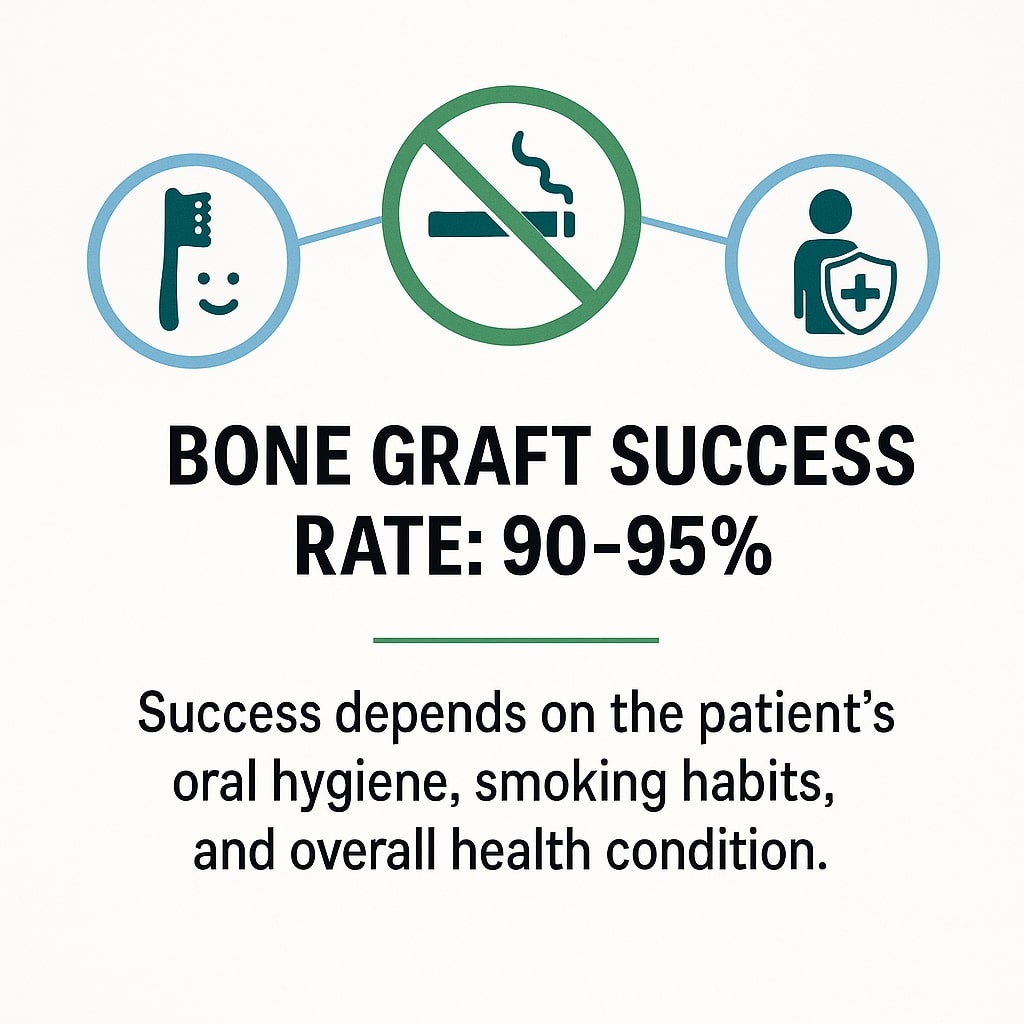
Dental bone grafts have an exceptionally high success rate, typically ranging from 90 to 95 percent. The patient's oral hygiene, smoking habits, and general health are the most significant factors that affect success. Nevertheless, the success of the treatment is also significantly influenced by the type of graft material used.
Frequently asked questions
Below, we have included answers to patient questions and frequently asked questions regarding bone grafts. For further information, please consult a specialist dentist.
Is a dental bone graft painful?
You won't feel any pain or discomfort during bone grafting because the procedure is done with local anaesthesia. But there may be some soreness or tightness in the wound areas after the procedure, but this usually goes away in a few days.
How long does recovery take after a bone graft?
On average, it takes 3-6 months for bone to form after gum tissue wounds heal in 1-2 weeks. For small-scale grafts (e.g. for 1-2 implants), 3-4 months is usually sufficient. The full healing process may vary depending on bone structure, graft type, and the patient's general health and oral hygiene.
Is it necessary to use a membrane in every bone graft?
The membrane prevents soft tissue from entering large or open defects, so it is necessary in those cases. However, it is not necessary in small or closed grafts. The surgeon determines this based on the morphology of the defect and the thickness of the soft tissue.
Are human- or animal-derived grafts safe?
Yes, as they are completely sterilised and devoid of antigenic cells, there is no risk of disease or rejection. These materials have been used safely in millions of cases worldwide.
Can bone grafting be performed in patients with diabetes or osteoporosis?
Yes, it can be performed as long as diabetes is under control. In unmanaged diabetes, the physician implements precautions and modifies the treatment regimen accordingly. In patients with osteoporosis, the utilisation of medication and bone density are meticulously assessed.
How long after bone grafting can an implant be placed?
It typically ranges from 3 to 9 months. The patient's overall health and the body's response to wound healing are critical determinants of treatment duration. Furthermore, this period can be shorter or longer depending on the type of graft material and the rate of bone formation.
How can you tell if a bone graft has failed?
When grafts don't work, you might notice some discomfort, bleeding, or receding gums. Additionally, X-rays make the lack of osseointegration very evident. In such cases, the graft can be re-evaluated with early intervention.
Is bone grafting always necessary for implants?
No, it is not always necessary. It is recommended if an implant plan is in place or if bone loss is expected after extraction. However, if there is sufficient bone volume, implants can be placed without grafting.
What happens in the space after extraction? Can a graft be performed at a later stage?
Within the first 3-6 months after extraction, the bone rapidly shrinks. When teeth shrink, it weakens the jawbone and shifts the position of neighbouring teeth. Bone grafting can be performed years after extraction, but the volume of treatment and technical requirements increase.
Is using my own bone (autograft) the best option?
Autograft is the most biologically reliable technique as it comprises living cells and growth factors. Nonetheless, due to the necessity of an additional surgical site, it may not always be favoured regarding patient comfort and recovery duration.
Can bone grafting be avoided with short implants?
In some cases, yes. However, bone quality, occlusion and chewing forces must be carefully evaluated. When the right cases are selected, short implants can demonstrate long-term success.
My surgeon did not use a membrane; is this normal?
Yes, in some cases it may not be necessary. The type of defect, soft tissue thickness and graft stability are factors that influence the decision-making process.
Is it reasonable to use bone chips produced during surgery as grafts?
Yes, it is often done. Autograft chips collected during drilling can be used to fill the defect. This method improves graft compatibility and healing speed.
Is whiteness, swelling or discharge of particles in the gums after grafting normal?
These symptoms are normal in the first few weeks. However, if there is odour, pain or inflammation, a dentist should be consulted. Colour change is usually a sign of new tissue formation.
What is the success rate of grafts and implants in diabetic patients?
The success rate is high in well-controlled diabetes. We recommend that appointments be scheduled without fasting, and blood sugar balance should be maintained. If the risk of infection is under control, the results are similar to those in normal individuals.
What is the success rate of bone grafting?
Bone grafting treatment has an average success rate of 90%. The patient's general health, diabetes, use of bone growth-promoting drugs, oral hygiene, and smoking are the most important factors affecting the success rate.
What factors influence the cost of a bone graft?
The cost varies depending on size, material and area. The type and the quality of the material used also affect the price.
Can grafting and implanting be performed again in patients who have previously experienced implant loss?
Yes, it is generally possible. However, the reason for failure must be analysed and the plan adjusted accordingly. With proper preparation, second attempts can also be quite successful.
Is a mixture of autograft and synthetic/xenograft effective?
Yes. Autografts support biological compatibility, while other materials provide volume and stability support. This combination yields good results both biologically and mechanically.
Can bone grafting be performed around the teeth to preserve existing teeth?
Yes, it is possible in certain periodontal defects. However, it is not suitable in every case; the mobility of the tooth and the root structure are important.
Can intraoral bone protrusions be used as donors?
Yes, it can be considered as an autograft source in suitable anatomy. This method is generally preferred for small-volume grafts.
What is the best artificial graft material?
There is no single "best" product. The choice is made according to the type of defect, biomechanical requirements and patient preference. Current synthetic materials are clinically very successful.
Can grafting and implanting be performed in the same session?
Yes, it is a safe method frequently used, especially for small defects. However, the stability of the graft and the primary stability of the implant must be ensured.
What happens if an implant is not placed after a graft?
The graft material gradually transforms into the body's own bone over time. However, if the implant is not replaced for an extended period, a natural amount of bone resorption may occur. Therefore, regular monitoring of the area is recommended.
What does whiteness, swelling or hardness in the graft area mean?
Whiteness is usually new epithelial tissue; slight swelling is normal. However, if there is pain or a foul odour, infection may be suspected. Hardness is usually a natural part of the ossification process.
What should post-graft nutrition and oral care be like?
Soft foods rich in protein and vitamins (yoghurt, eggs, soup, smoothies, etc.) should be preferred. During the first week, hot, hard or spicy foods should be avoided, and the area should be cleaned gently.
When is severe pain or swelling after grafting dangerous?
Mild pain is normal for the first 3-5 days; however, increasing pain after the third day is a sign of infection. Persistent pain must be evaluated.
Is a bone graft absorbed by the body or does it remain permanently?
The graft is gradually converted by the body into living bone; it acts as a scaffold. It does not disappear completely, but is replaced by new bone tissue.
If a graft is taken from the hip bone, will there be any pain or scarring?
Taking a piece of bone from the hip bone is a fairly common procedure. It is normal to experience short-term, mild pain after treatment. However, a minimal scar usually remains.
Is it normal for hard pieces to come out of the gums after a graft?
Yes, small pieces coming to the surface are part of the healing process of the treatment. However, if these pieces are coming out very intensely and continuously, then dental intervention is required without delay.
Is it normal to feel stiffness or pressure in the graft area?
Yes, it is part of the integration process. However, if there is pain or swelling, an assessment is required. Hardness usually indicates that the bone is forming.
What should be done if there is an infection prior to sinus lifting or bone grafting?
The active infection must be treated first; otherwise, the graft will fail. Once the infection is under control, the procedure can be performed safely.
Is it normal to have fluid discharge or an open wound weeks after surgery?
No, this could be a sign of infection. Specialist examination is required. Early intervention helps to protect the graft.
Is it normal for fluid to come out of the nose after an upper jaw graft?
A small amount of fluid is normal; if there is a foul odour or persistent discharge, the sinus membrane may be problematic. In this case, a sinus assessment is required.
Is it normal to be unable to open your jaw fully after a bone graft?
Yes, it may be temporary due to muscle tension and swelling. It usually resolves within 1-2 weeks. Light exercise can support the recovery process.
Is bone grafting risky in patients with congenital cleft?
These cases require a multidisciplinary assessment. They are generally successful; however, if nasal discharge persists, a follow-up is required. A specialist surgical team is of critical importance in such cases.
Can bone grafting be performed during the same session as an infected tooth extraction?
Infection should generally be treated; however, in controlled cases, this can be done with antibiotic support. This depends on the clinician's clinical assessment.
How long does the swelling and sensitivity last after the graft?
Swelling usually peaks after 2-3 days and subsides within a week. Sensitivity may last for 10-14 days. Cold compresses and medication are beneficial to support healing.
Resources:
1- ITI Academy "General Risk Factors and Contraindications for Implant Therapy" by Alejandro Trevino.
2- Why synthetic bone grafts could be a beneficial solution among the latest trends in dental bone grafting

Dt. Dilek Aksu Güler
Cosmetic Dentist, Dental Implant Specialist
Dt. Dilek Aksu Güler specializes in implantology, digital smile design and cosmetic dentistry. She is the founding dentist of Antlara Dental Oral and Dental Health Clinic.