
Most adults have 32 teeth. That total includes the four wisdom teeth, and because a great many people either never develop all four or have them taken out, 28 is just as normal. Both numbers are right, which is why the answers you find online seem to contradict each other.
The teeth divide evenly between the jaws: 16 on top and 16 on the bottom. Within each jaw sit four incisors at the front, two canines, four premolars and six molars, and the last molar on each side is the wisdom tooth.
If you have counted your own teeth and landed somewhere else, it is worth reading on. Tooth count varies more than most people expect, and the reasons range from entirely harmless to something a dentist should look at sooner rather than later.
The 16 teeth, symmetrically positioned in the upper and lower jaws, enhance our health through their chewing and aesthetic roles. These figures also represent the transition from childhood to adulthood and the genetic or clinical variations that individuals may experience. Even a minor deviation in tooth count can set off a chain reaction of dental complications, significantly impacting overall health, dietary habits, and quality of life.
How Many Teeth Adults Have?
Adults have 32 permanent teeth. This set of teeth is
- 8 incisors
- 4 canine teeth
- 8 premolars (premolars)
- 12 large molars (molars). Four of these 12 molars are wisdom teeth (third molars), which are usually extracted.
However, in most cases, wisdom teeth are extracted, reducing the total number of teeth to 28. Additionally, extractions may be performed for orthodontic purposes, such as preparing for braces. Tooth loss remains a prevalent issue among adults. Notably, according to CDC data, 26% of adults aged 65 and older have eight or fewer teeth, while one in six individuals in this age group is completely edentulous. Click for complete edentulism treatments all-on-4 and all-on-6.
How many teeth do adults have on top?
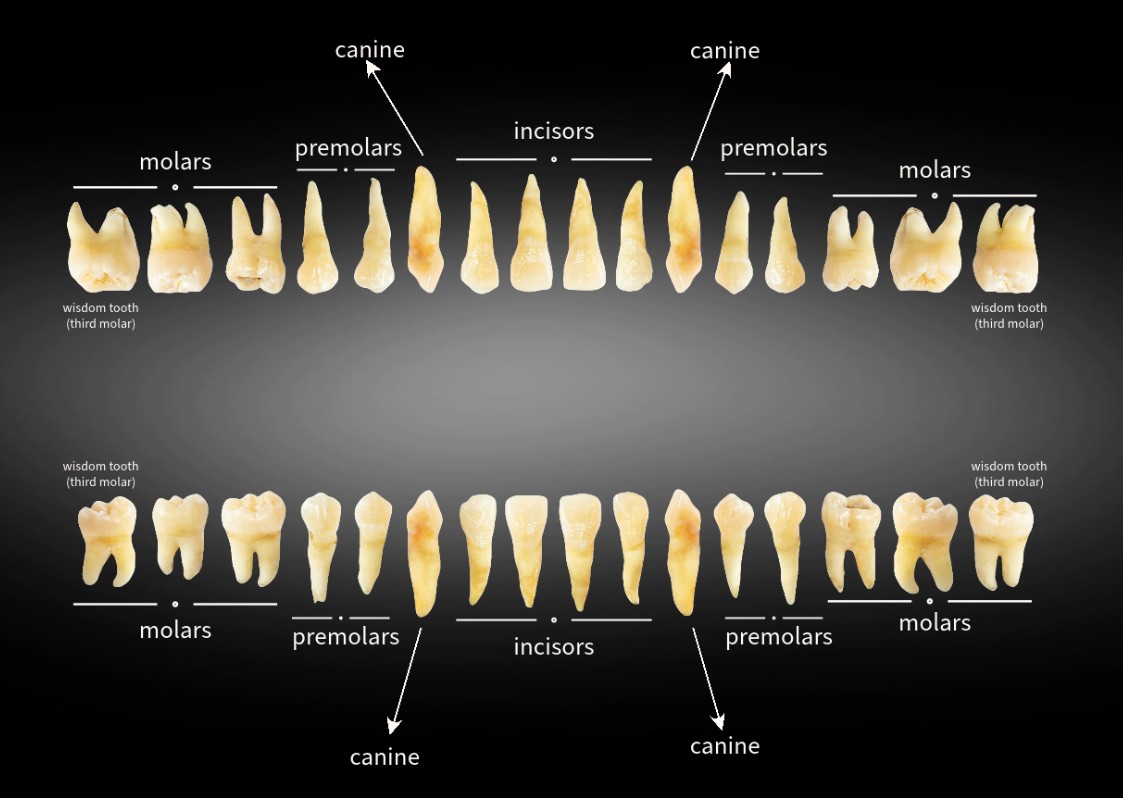
Adults have a total of 16 permanent teeth in the upper jaw. These 16 teeth are classified into four different types:
- The four incisors: These are sharp-edged teeth located in the midline and perform the biting function. There are four in the upper jaw.
- Two canines (canines/cusps): These are pointed teeth located next to the incisors and help to tear food. There are two in the upper jaw.
- Four premolars (premolar/bicuspids): They are located behind the canines and function to crush and grind food. There are four in the upper jaw. In children, these teeth erupt after the milk teeth fall out.
- Six large molars (molars): The largest and strongest teeth located behind the premolars. They play an important role in grinding food. There are six in the upper jaw. These six molars include two wisdom teeth (third molar).
How many teeth do adults have on the bottom
Just like the upper jaw, adults have a total of 16 permanent teeth in the lower jaw. These 16 teeth are also classified into four different types:
- The four incisors: They are located in the front part of the lower jaw and perform the biting function.
- Two canines (canines/cusps): They are located next to the lower incisors and help to tear food.
- Four premolars (premolar/bicuspids): They are located behind the lower canines and function to crush and grind food.
- Six premolars (molars): They are the largest teeth behind the lower premolars and play an important role in grinding food. These six molars include two wisdom teeth (third molar).
How many teeth do adults have with wisdom teeth
Wisdom teeth are located at the very back of each jaw, at the end of the other molars. Therefore, if an adult has all their permanent teeth erupted and their wisdom teeth have not been extracted, they have a total of 32 teeth in their mouth.
How many teeth do adults have without wisdom teeth
If all four wisdom teeth of an adult have been extracted or have never erupted, a total of 28 permanent teeth remain in the mouth. These 28 teeth consist of 8 incisors, 4 canines, 8 premolars, and 8 molars.
How many teeth does a child have
Children have a total of 20 milk teeth. These teeth are distributed with 10 in the upper jaw and 10 in the lower jaw. A child's milk teeth include
- 8 incisors
- 4 canines
- 8 molars (molars)
Milk teeth do not have premolars (small molars).
How many teeth does a child have to lose
Children lose a total of 20 milk teeth as permanent teeth come in to replace the milk teeth. These teeth usually fall out from around the age of 6 until around the age of 12 and are replaced by permanent teeth.
How many teeth should a 7 year old have?
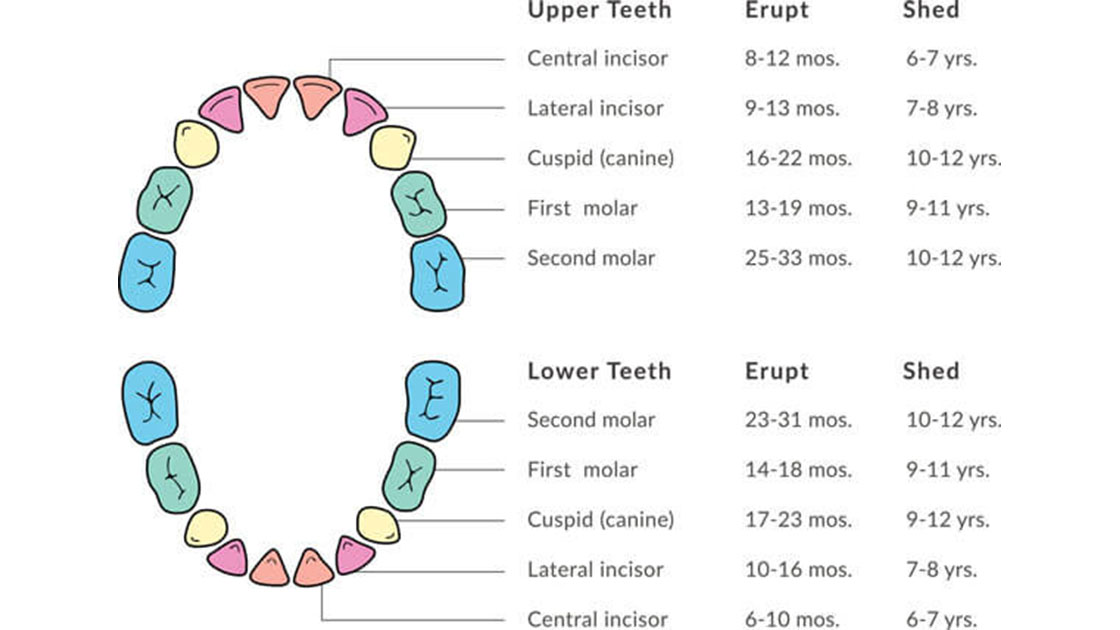
A 7-year-old child may be in the mixed dentition period. During this period, both milk teeth and the first permanent teeth may be present in the mouth. The first permanent tooth usually erupts around the age of 6. A 7-year-old child may still have some baby teeth and some permanent teeth may have erupted. Therefore, the number of teeth a 7-year-old child has can vary from person to person. In general, however, at this age, a child is likely to have more than 20 and less than 32 teeth, as permanent teeth begin to replace the milk teeth.
How many teeth should a 12 year old have?
In most children, the transition from primary to permanent dentition is typically complete by the age of 12. By this stage, all primary teeth have been shed and replaced by 28 permanent teeth. However, the third molars (wisdom teeth) have usually not yet erupted at this age. As a result, a 12-year-old generally has a full set of 28 permanent teeth.
When a child has 24 teeth?
A child may have 24 teeth during mixed dentition. This refers to a period of time when some baby teeth are still in the mouth and some permanent teeth are beginning to erupt. For example, a child may have 24 or more teeth in his or her mouth after the age of 6 when he or she retains the first permanent molars and has not yet lost all his or her baby teeth. Because the timing of the loss of deciduous teeth and eruption of permanent teeth can vary from individual to individual, it is difficult to give an exact age range when 24 teeth appear, but it can usually occur sometime between the ages of 6 and 12.
Do children have 28 teeth?
Yes, children may temporarily have 28 teeth during the mixed dentition phase, when both primary and permanent teeth coexist. By the age of 12, some children may have 28 permanent teeth if all primary teeth have been shed and the wisdom teeth have not yet erupted. This transitional stage reflects the ongoing process of tooth replacement.
Why do I only have 28 teeth at age 18?
The main reason why you only have 28 teeth at age 18 is most likely because your wisdom teeth (third molars) have not yet erupted or have been extracted.
Here are the specifics that shed light on the matter:
- Normally, adults have 32 permanent teeth. This number includes 4 wisdom teeth.
- Wisdom teeth usually erupt between the ages of 17 and 25. So, if you are 18 years old, it means that these teeth may not have erupted yet.
- Most people have their wisdom teeth removed. Sometimes, these teeth can become impacted because there is not enough space in the mouth, in which case they may need to be extracted. Orthodontists may also extract wisdom teeth for orthodontic purposes or prior to brace treatment.
What are The Different Types of Teeth?
There are four main types of teeth. These types differ according to their shape, position, and function.
- There are 8 in total, both in the upper and lower jaw.
- They are located in the front part of our mouth.
- They have sharp edges and help us bite into food. They are the teeth we use when we first bite into something.
- The first teeth to erupt are usually incisors, which begin to erupt at around six months of age.
- There are 4 in total, both in the upper and lower jaw.
- They are located next to the incisors. There are two in the upper jaw and two in the lower jaw.
- They have a pointed surface and are used for tearing food.
- There are 8 in total, both in the upper and lower jaw. There are four on the top and four on the bottom.
- They are located behind the canines.
- They have a flat surface and ridges. Thanks to this structure, they function to crush and grind food.
- Babies and young children do not have premolars in their milk teeth. These teeth start to erupt around the age of ten and replace the baby molars.
- There are 12 in total, both in the upper and lower jaw. There are six on the top and six on the bottom.
- They are located behind the premolars.
- They are our biggest and strongest teeth. They help us grind food thanks to their large surface area. Our tongue pushes food to the back of our mouth and our molars break it down into pieces small enough to swallow.
- The molars include the wisdom teeth (third molars) and there are four in total. These teeth usually erupt between the ages of 17 and 25. In some people, there may not be enough space for these teeth and they may remain impacted, in which case they may need to be extracted.
Incisors:
Canines/Cusps:
Premolars/Bicuspids:
Large molars (Molars):
How Adult Teeth Grow In
Adult teeth gradually take their place as the baby teeth fall out. This process continues from about 6 to 12 years of age, while wisdom teeth may erupt later or not at all. An adult normally has 32 permanent teeth, but if the wisdom teeth do not erupt or are extracted, the number may be 28.
What if You Have Fewer Than 28 Teeth?
This is the question behind most tooth counting, and it rarely gets answered properly. Coming up short of 28 usually has one of three explanations.
A tooth was removed
Decay that reached too far, advanced gum disease that loosened the tooth, a crack or an injury. Extraction is the most common reason an adult count drops, and it is the only one of the three where the gap was not always there.
A tooth never formed
Some teeth simply never develop, a condition called hypodontia. Missing wisdom teeth are so common that they are barely worth remarking on. Beyond those, the teeth most often absent from birth are the upper lateral incisors, the small teeth on either side of the two front teeth, and the second premolars. People frequently reach adulthood without realising, because the baby tooth in that position can stay put for years.
A tooth is there but has not come through
An impacted tooth has formed but is blocked, either by lack of space or by its own angle. Wisdom teeth are the usual case, and an impacted one can press on its neighbour and cause pain well away from the tooth itself. Impacted teeth do not show up in a mirror count, only on an x-ray.
Why the gap matters more than the number
A missing tooth is not only a missing tooth. The bone that held its root is no longer being loaded when you chew, so it slowly reduces in volume. The teeth on either side drift toward the space and the opposing tooth drifts down into it, which changes how your bite meets. Over years, several missing back teeth can also alter the support of the lower face, one of the reasons missing teeth can make people look older than they are.
None of that happens quickly, and none of it is a reason to panic over a single gap. It is a reason to have the space assessed rather than ignored. Depending on where it sits and how much bone remains, the usual options are a dental implant, a bridge, or a removable denture for a single tooth. We have set out how these compare, including cases where an implant is not the right answer, in our guide to alternatives to dental implants.
Can You Have More Than 32 Teeth?
Yes, though it is much less common than having fewer. Extra teeth beyond the normal set are called supernumerary teeth, and the condition is hyperdontia. The one that turns up most often is a mesiodens, a small extra tooth sitting between the two upper front teeth.
Most supernumerary teeth are found on a routine x-ray rather than by the patient, because many never erupt. They matter when they crowd the teeth around them, block a permanent tooth from coming through, or push the front teeth apart. In those cases they are usually removed. When they cause no trouble at all, they are often simply monitored.
What is the national tooth notation system?
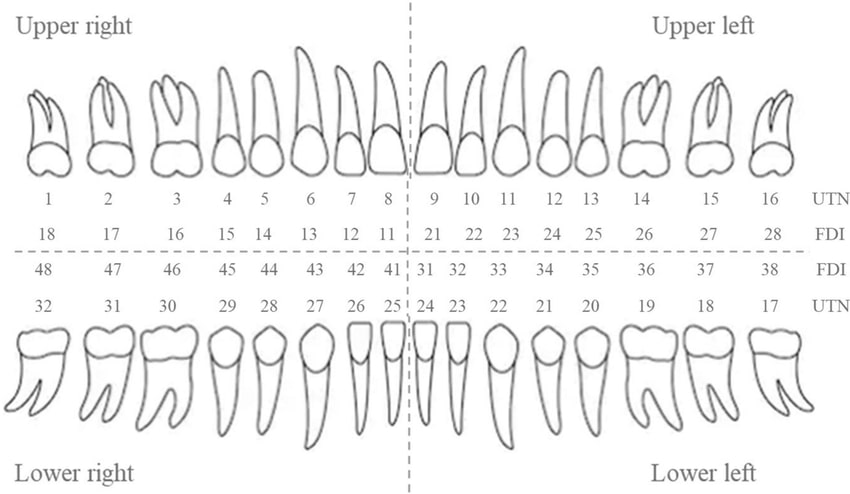
The national tooth numbering system is the widely used tooth numbering system approved by the American Dental Association (ADA) in the United States. This system is also known as the Universal tooth numbering system.
In this system, permanent teeth are numbered from 1 to 32. The numbering starts as follows:
- The upper jaw starts from the right third molar (wisdom tooth) (tooth number 1) and continues along the upper jaw to the left third molar (tooth number 16).
- Then, it moves to the lower jaw and starts with the left third molars (tooth number 17) and continues along the lower jaw to the right third molars (tooth number 32).
For deciduous teeth, letters are used in the same system. The upper jaw starts with the right second molars (A) and the letters are arranged along the upper jaw until the left second molars (J). Then move to the lower jaw and start with the left second molars (K) and continue with letters up to the right second molars (T).
The American Dental Association officially recommended the Universal tooth numbering system in 1968. This system is said to be more easily accepted by computers and causes less confusion.
What is the FDI numbering system for teeth?
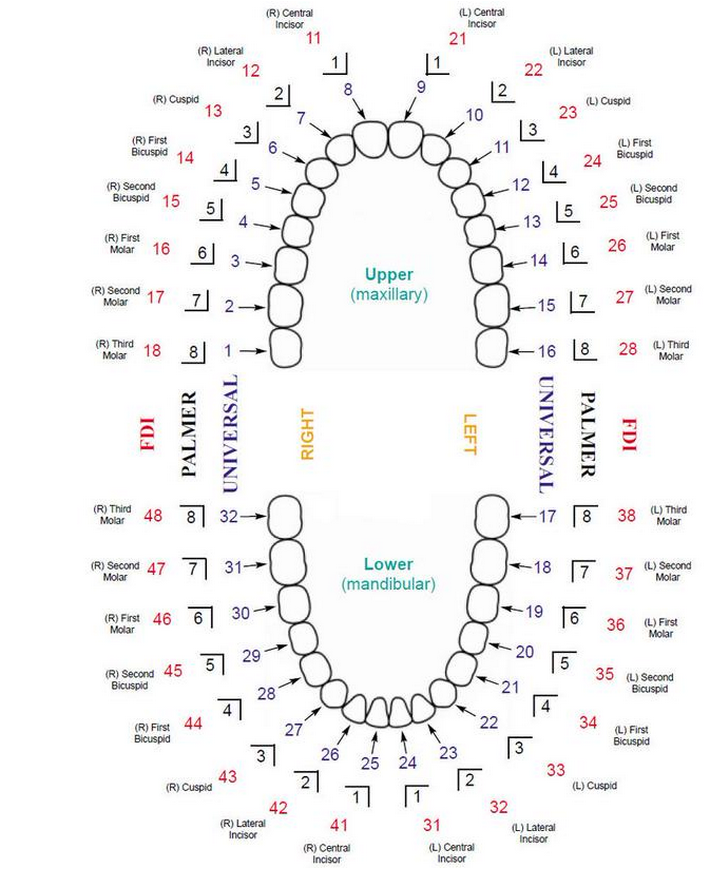
In the FDI system:
The first digit indicates the quadrant for permanent teeth.
1: Upper jaw right quadrant
2: Left quadrant of the upper jaw
3: Lower jaw left quadrant
4: Lower jaw right quadrant
The second digit indicates the position of the tooth in that quadrant, numbered from 1 to 8 starting from the middle (central incisor 1, lateral incisor 2, canine 3, first premolar 4, second premolar 5, first molar 6, second molar 7, third molar 8).
For example, the number 11 refers to the maxillary right central incisor and is pronounced "one one", not "eleven".
The first digit in the FDI system for deciduous teeth ranges from 5 to 8 (clockwise):
5: Upper jaw right quadrant
6: Left quadrant of the upper jaw
7: Lower jaw left quadrant
8: Lower jaw right quadrant
The second digit indicates the position of the tooth in that quadrant, numbered from 1 to 5 starting from the center (central incisor 1, lateral incisor 2, canine 3, first molar 4, second molar 5).
What is the ISO numbering system for teeth?
The ISO tooth numbering system is identical to the FDI (World Dental Federation) tooth numbering system described above. Due to its widespread acceptance by groups like the World Health Organization, the FDI system can be thought of as a benchmark on a global scale.
What is the ADA numbering system for teeth?
The ADA tooth numbering system is the Universal/National tooth numbering system detailed above. It is approved by the American Dental Association and is the most widely used system in the United States. In this system, permanent teeth are numbered from 1 to 32, while deciduous teeth are indicated by letters from A to T.
Factors Affecting Changes in Tooth Number:
Adults normally have 32 permanent teeth, but various factors can cause this number to change. These are;
- Genetic Factors: In some individuals, wisdom teeth may not develop at birth, in which case the person will have 28 teeth instead of 32.
- Tooth Extraction: Extraction of wisdom teeth (third molars) or extraction of other teeth due to decay, infection or trauma reduces the number of teeth.
- Accidents and Tooth Loss: Sports injuries or accidents can lead to tooth loss. In addition, poor oral hygiene, excessive consumption of sugary foods, and smoking can lead to tooth decay and gum disease, increasing tooth loss.
- Orthodontic Treatments: If there are too many teeth in the mouth, some teeth may need to be extracted before orthodontic treatment.
Why are wisdom teeth extracted or preserved?
Wisdom teeth are the last teeth to erupt in the mouth and usually appear between the ages of 17 and 25. If these teeth erupt properly, they blend in with your teeth and do not cause any problems; in this case, it may be preferable to keep them.
However, in most cases, the wisdom teeth are not positioned correctly due to lack of space or angles. Such placement can lead to impacted teeth and pressure on other teeth, causing pain, soreness, and risk of infection. It can also make oral hygiene difficult and cause cavities or gum problems. In such instances, your dentist may advise the extraction of the wisdom teeth. Given the variability in individual oral anatomy, the determination to extract wisdom teeth should be contingent upon one's specific circumstances. So, routine dental examinations are essential for identifying healthy teeth and those that may exhibit issues.
How Many Teeth Do Adults Have? Common Questions
The questions patients ask us most often about tooth count.
Both answers are correct depending on the wisdom teeth. The full adult set is 32, which includes four wisdom teeth at the very back. Because many people never develop all four, and many others have them extracted, 28 is an extremely common adult count and is not considered abnormal. If you are counting at home, note that wisdom teeth sit far back and are easy to miss.
Sixteen, assuming a full adult set, and the same sixteen in the lower jaw. Each jaw holds four incisors at the front, two canines, four premolars and six molars. Without wisdom teeth the figure drops to fourteen per jaw. The upper and lower sets are not identical in shape: upper molars typically have three roots while lower molars usually have two.
A full set of baby teeth is 20, ten in each jaw, and they are usually all through by around age three. Children have no premolars, which is the main reason the count is lower than an adult's. The first permanent teeth arrive around age six, and from then until roughly age twelve a child has a mix of baby and adult teeth at the same time.
Almost always because of the wisdom teeth. Either they never formed, which is common and harmless, or they were removed, or they are still under the gum and have not erupted. A count of 28 with all other teeth present and healthy is not a problem and needs no treatment. An x-ray is the only way to tell which of the three explanations applies to you.
Yes. Wisdom teeth are the teeth most often missing from birth, and having none at all is a recognised normal variation rather than a defect. They are also the teeth we least need, since the jaw manages perfectly well without them. Many dentists regard never developing them as an advantage, because it removes the risk of impaction and the extraction that often follows.
Twelve in a full set, three on each side of each jaw. These are the first molar, the second molar and the wisdom tooth. Without wisdom teeth the figure is eight. Molars do the bulk of the chewing and carry the heaviest load, which is also why they are the teeth most commonly lost to decay and most commonly replaced with implants or crowns.
Most permanent teeth are in place by around age thirteen, once the second molars have come through. The wisdom teeth arrive much later if they arrive at all, usually between seventeen and twenty five, which is where the name comes from. So a seventeen year old with 28 teeth and no wisdom teeth yet has a complete set for their age.
Yes, though it is uncommon. Extra teeth are called supernumerary teeth and the condition is hyperdontia. The most frequent example is a small extra tooth between the two upper front teeth. Many never erupt and are discovered on an x-ray. They are removed when they crowd neighbouring teeth, block a permanent tooth from coming through, or open a gap at the front.
There is no single number, because position matters far more than count. Losing a wisdom tooth changes nothing. Losing several back teeth on the same side has a much larger effect than losing the same number spread around the mouth, because chewing is done by the molars and premolars meeting their opposite pair. A dentist assesses the pairs that still meet, not the total.

Dt. Dilek Aksu Güler
Cosmetic Dentist, Dental Implant Specialist
Dt. Dilek Aksu Güler specializes in implantology, digital smile design and cosmetic dentistry. She is the founding dentist of Antlara Dental Oral and Dental Health Clinic.