
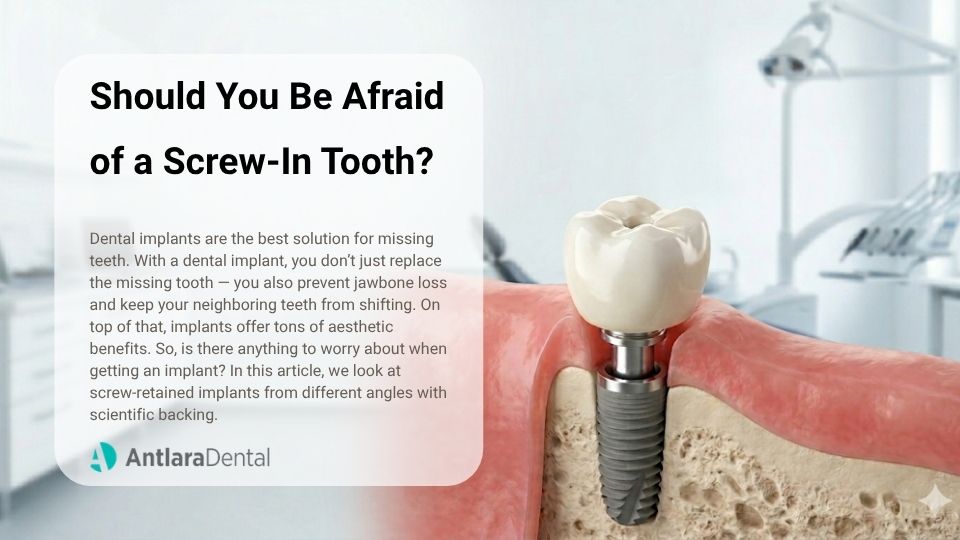
Dental implants are the best solution for missing teeth. With a dental implant, you don’t just replace the missing tooth — you also prevent jawbone loss and keep your neighboring teeth from shifting. On top of that, implants offer tons of aesthetic benefits. So, is there anything to worry about when getting an implant? In this article, we look at screw-retained implants from different angles with scientific backing.
High success rates
When done properly and if you keep up good oral hygiene, a dental implant can last 20 to 30 years in a healthy person. In fact, a review of studies from 2000 to 2012 found that screw-retained implants have about a 96% success rate after five years. Other research has shown similar results.
Removability is a big practical advantage
Screw-retained implants can be unscrewed and reattached when needed, which is a big practical advantage if you ever have gum issues, need to adjust the bite, fix or repair the crown, or for cleaning and check-ups. With cemented (glued) implants, you'd have to remove the crown completely to replace or work on it.
Biological risks
With cemented restorations, one of the biggest biological risks is leftover cement under the gum. These bits of cement can cause inflammation in the gum tissue and compromise the implant's success. The screw-retained system avoids this problem entirely, since there's no cement used.
One study by Thomas G. Wilson Jr. found that most implants with signs of peri-implant disease had excess cement — in fact, 81% of the tested implants had leftover cement. After cleaning out the cement, inflammation signs disappeared in 74% of those cases after 30 days. With screw-retained implants, you don't have that issue at all, since there's no cement involved.
Risk of crown falling off
Losing the crown (it coming loose) is a common problem with cemented implants. Screw-retained implants don't have this issue — your implant won't let you down, so you can use it confidently. Studies have shown that cemented crowns can lose their retention over time, but screw connections stay solid.
Cemented crown failures can happen for various reasons: the height of the abutment, the type and technique of cement used, heavy grinding or clenching forces, contamination, and the gradual breakdown of cement over time. That's why you can't always eliminate the risk of a crown coming loose with a cemented restoration.
Possible disadvantages of screw-retained systems
Screw-retained implant systems are popular, but they're not totally free of issues. You might see small chips or fractures on the ceramic surface. This is usually due to thin design, heavy chewing forces, grinding habits, or choice of material. Using sufficiently thick, durable materials, properly balancing the bite, and recommending a nightguard when needed can largely control this risk. In other words, the problem usually isn't the implant system itself, but the design and how the forces are managed.
Screw loosening
Screw loosening can rarely happen with screw-type implants. When it does, you don't hear “my tooth fell out!” Instead, you might feel “my tooth is wobbly” or “my bite feels different.” In most cases, simply re-tightening to the correct torque and adjusting the bite fixes it easily. So it's not a permanent failure — just a mechanical issue that can be managed with follow-up and the right technique.
Concern about the visibility of the screw access hole
Screw-retained systems have a small hole to access the screw. Usually this isn't a problem for back teeth, but in the front, if the implant angle isn't well planned, it can be an aesthetic challenge. That's why careful planning is crucial. Nowadays, with digital planning and guided surgery, dentists can set the implant position in advance to control where the screw hole ends up. And once the hole is covered with tooth-colored filling material, it's basically invisible.
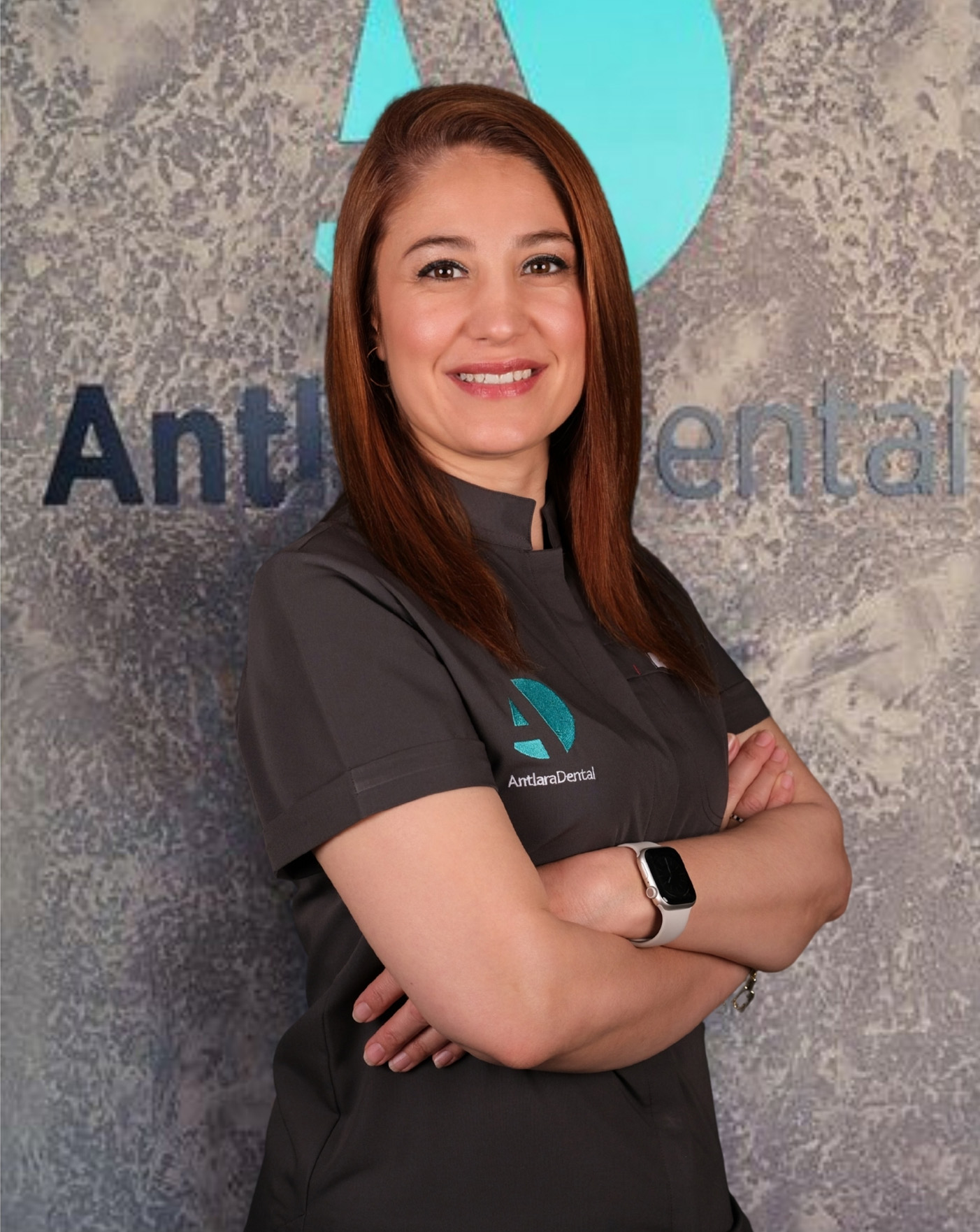
Dt. Dilek Aksu Güler
Cosmetic Dentist, Dental Implant Specialist
Dt. Dilek Aksu Güler specializes in implantology, digital smile design and cosmetic dentistry. She is the founding dentist of Antlara Dental Oral and Dental Health Clinic.