
Toothaches often start suddenly, and many people's first instinct is to think about taking antibiotics. However, not every toothache has the same cause, and not every kind of pain requires antibiotics. In fact, in most cases, antibiotics only suppress the symptoms temporarily rather than solving the problem. In other words, they create the right conditions for treatment and help keep the infection under control.

Below, we cover antibiotic use for toothaches from every angle. However, the information here is for informational purposes only; for the most accurate and definitive assessment, you should always consult your dentist.
Why do tooth infections usually occur at the root tip?
With the progression of the infection, the bacteria within the tooth migrate down the root canals. Thus, while the infection starts within the tooth, the inflammation caused by the body primarily manifests in the bone near the tip of the root.In dentistry, the term "apex" is frequently employed to describe the outermost portion of the tooth root. Since many infections seen on X-rays are located at the root tip, dentists often use the terms "apical lesion" or "apex infection." This is a sign that the infection has progressed beyond the tooth and is now affecting other tissues in the area.
When are antibiotics used?
Your dentist decides whether to prescribe antibiotics by looking at the effects of the infection. If you are experiencing the symptoms below along with tooth pain, it means the issue has gone beyond a local problem.
Signs of spread: Limited ability to open the mouth (trismus), difficulty swallowing, or difficulty breathing.
Swelling visible from the outside: The infection has clearly spread toward the jaw or face.
Systemic symptoms: A fever of 38°C or higher, weakness, fatigue, and swollen lymph nodes.
These symptoms are some of the clearest signs that the body is struggling to fight the infection and that antibiotic support may be necessary.
Using antibiotics as a preventive measure
Prophylactic (preventive) antibiotic use means giving an antibiotic dose to prevent an infection from spreading when there is not yet an active infection in the body. In some patient groups, preventing bacteria from entering the bloodstream is especially important.
Who falls into a high-risk patient group?
- People at risk of infective endocarditis (The most important group)
- People with artificial (prosthetic) heart valves
- People who have had endocarditis before
- People with certain congenital heart diseases
- People who develop valve disease after a heart transplant
- Patients with hip or knee prostheses, especially within the first 2 years or if their immune system is weak. (Assumption: the source list is compressed here, and this note most naturally appears to apply to this group.)
- Uncontrolled diabetes: infection risk is higher
- Wound healing is slower
- People receiving chemotherapy
- Organ transplant patients
- People taking corticosteroids / immunosuppressive drugs
- HIV/AIDS
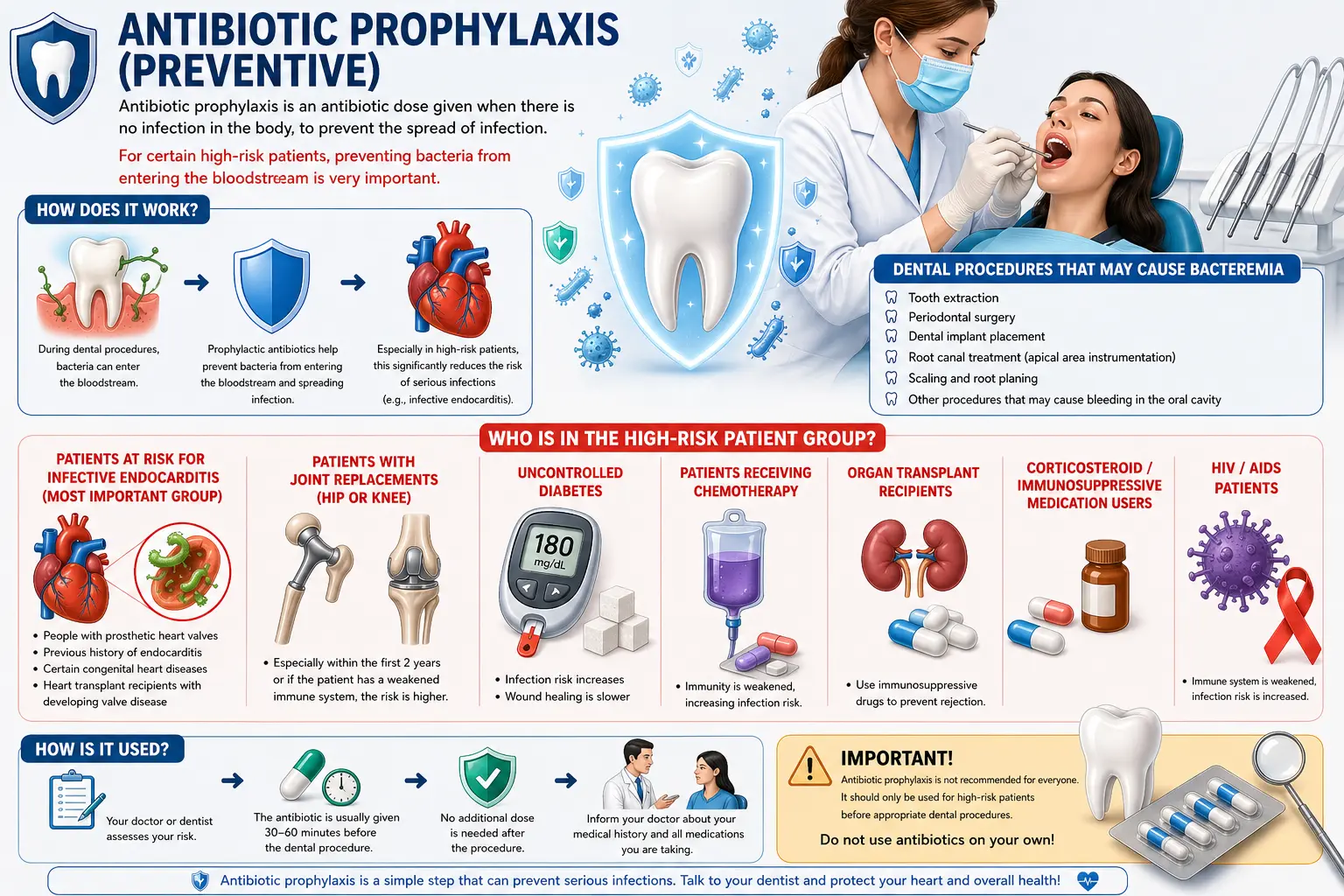
Preventive antibiotics are usually given before invasive procedures that may involve bleeding:
High-risk procedures
- Tooth extraction
- Implant placement
- Periodontal surgeries (gum surgeries)
- Sinus lift (sinus elevation)
- Curettage / deep cleaning (procedures involving bleeding)
- Surgical endodontic procedures such as apical resection
Why antibiotics are not the solution for every toothache
The unnecessary use of antibiotics for toothaches, or starting antibiotics on your own, can change the symptoms and mask where the pain is coming from, causing the dentist to focus on the wrong tooth. This can lead to serious mistakes such as unnecessary root canal treatment or extracting the wrong tooth.
Also, in some cases, antibiotics temporarily suppress the infection rather than eliminating it completely, making it “hidden”; this can make the infection harder to eliminate fully and make treatment more difficult. As long as the underlying problem continues after treatment, it can also lead to more advanced complications such as cystic formations or damage to the jawbone.
That said, in cases such as a dental abscess, the effect of antibiotics remains limited when there is pus inside. For this reason, in many dental infections, early local and surgical interventions have produced much better results.
Antibiotics in dental treatment and how they are used
Antibiotic use in dentistry is planned according to certain basic principles. When treatment is started before the exact causative microorganism is identified, short-term, broad-spectrum antibiotics are generally preferred. In particular, amoxicillin, amoxicillin-clavulanic acid, metronidazole, and clindamycin stand out in this group.
In clinical practice, antibiotic choice is made in a more structured way and according to a clear order of priority. Penicillin-group antibiotics, especially amoxicillin and its combinations, are generally considered the first choice. If the patient has a penicillin allergy, clindamycin becomes an important alternative. Metronidazole and similar agents are especially preferred in infections in which anaerobic bacteria play a role.
In addition, doxycycline has a more selective place, mostly in periodontal diseases. In rarer cases, some antibiotics may be considered as alternative options; however, not every antibiotic class has the same importance in dentistry, and the use of some groups is quite limited.
There is no one-size-fits-all approach to dose and treatment duration. The dose used varies depending on the patient’s age, systemic condition, how widespread the infection is, and the type of procedure being performed. For this reason, it is critically important not to start antibiotics without a clinician’s recommendation and not to use them randomly. Dose adjustments require special care, especially in children, pregnant women, and people with systemic disease.
Antibiotics used for dental infections
In cases of dental infection, certain antibiotics are the first choice due to their narrow spectrum of activity. Because of its potential for better absorption and patient compliance, amoxicillin is one of the most commonly prescribed of these. Another commonly prescribed antibiotic is co-amoxiclav, which acts on a wider range of bacteria. On the other hand, metronidazole is the most frequently prescribed antibiotic in cases of penicillin allergy.
Below is a table that compares the most frequently prescribed antibiotic options for outpatient oral treatment in adults.
Severe kidney or liver failure, pregnancy, breastfeeding, and children are all excluded from this table. For definitive information, though, you should see a doctor.
|
Antibiotic |
What is it used for? |
Common usage |
Treatment duration |
What you need to know |
|
Phenoxymethylpenicillin (Penicillin V) |
It is a narrow-spectrum antibiotic that is frequently chosen for the treatment of dental infections. |
It is typically administered orally twice daily at a dosage of 500 mg. For infections that are more severe, the dosage may be increased. |
Usually 3-5 days |
It is generally recommended as a first-line option due to its ability to mitigate the risk of the development of unnecessary antibiotic resistance. You should take it on an empty stomach. Individuals with penicillin allergies should refrain from utilising it. |
|
Amoxicillin |
It is a popular antibiotic for the treatment of dental abscesses and other oral infections. |
The dosage is usually 500 mg, three times a day. In severe infections, the dose can be increased to 1 gram. |
Usually 3-5 days |
It works similarly to penicillin but against a broader range of bacteria. Antibiotic resistance can thus result from their needless use. Individuals with penicillin allergies should not take this medication. |
|
Metronidazole |
It is a broad-spectrum antibiotic that is recommended for infections that are more complicated or resistant. |
Take 400 mg three times a day. |
Usually 3-5 days |
When treating severe infections, it can be combined with other antibiotics or used as a substitute for those who are allergic to penicillin. During treatment and for 48 hours following its completion, alcohol should not be consumed. |
|
Co-amoxiclav (Amoxicillin + Clavulanic Acid) |
It is a broad-spectrum antibiotic that is recommended for infections that are more complicated or resistant. |
The dosage varies depending on the product used; it is commonly used 2 or 3 times a day. |
It depends on the doctor's recommendation. |
Because it has a broader spectrum of action, it is not the first choice for every infection. Taking it with food may reduce gastrointestinal complaints. |
|
Azithromycin |
It is preferred as an alternative for some patients who cannot use penicillin-group drugs. |
It is usually taken at 500 mg once a day. |
It can vary between 3-10 days. |
Those who suffer from specific cardiac rhythm disorders should exercise caution when using it. Some medications for high cholesterol, blood pressure, and blood thinners may also have an adverse reaction. |
|
Clarithromycin |
It is an alternative treatment option for some resistant or widespread infections. |
It is usually taken in doses of 250–500 mg twice a day. |
Usually 5 days |
Patients who are allergic to penicillin may be eligible for this treatment option. Patients with cardiac rhythm disorders, liver disease, or kidney disease should use it with caution. |
|
Clindamycin |
While it was frequently used in the past for dental infections, nowadays it is preferred more in specific and serious cases. |
The dosage is usually 300 mg four times a day. The dose may be increased in severe infections. |
Usually 5 days |
Because it can affect the gut flora, it can increase the risk of severe diarrhea or intestinal infection. If severe diarrhea develops during treatment, a doctor should be consulted immediately. |
Procedures aimed at eliminating the source of the infection always form the foundation of treatment.
Risks, side effects, and antibiotic resistance
When used correctly, antibiotics can be lifesaving, but careless use can lead to serious problems. That is why caution is necessary both for individual patients and for society as a whole.
Some antibiotics are not suitable for everyone. For example, when the tetracycline group is used in children and during pregnancy, it can cause permanent discoloration of the teeth. That is why this group of drugs is especially avoided in certain situations. An allergy history should also always be checked before using antibiotics, because serious allergic reactions can develop in some people.
In addition, antibiotics can have different side effects:
- Stomach and intestinal problems (such as nausea and diarrhea)
- Digestive system complaints
- Disruption of vitamin balance with long-term use
Unnecessary antibiotic use both increases these side effects and can make treatment more difficult.
Antibiotic resistance
One of the most critical issues in the use of antibiotics in dental treatment is antibiotic resistance. As a result of incorrect or unnecessary use, bacteria develop resistance to drugs over time. This causes treatments to become ineffective.
Studies show that resistance rates to some antibiotics are quite high:
- Clindamycin: 46.7% (→ In situations where this antibiotic is used, roughly half of the bacteria are resistant to the drug. In other words, the expected effect may not be seen in 1 out of every 2 patients.)
- Amoxicillin: 39.2% (This antibiotic may not be sufficient in about 4 out of every 10 patients.)
- Doxycycline: 25% (It may be ineffective in 1 out of every 4 patients.)
- Metronidazole: 21.7% (It may not show a sufficient effect in about 1 out of every 5 patients.)
In contrast, resistance rates have been found to be lower in some combination treatments:
- Amoxicillin + Metronidazole combination: 6.7%
As you can see, the antibiotic chosen can seriously lower the success of treatment.
Special groups and situations that change the choice
In some patient groups, antibiotic use must be evaluated much more carefully and on an individual basis. In these groups, the patient's overall health directly shapes the treatment plan rather than a standard approach.
Antibiotic choice is made more carefully, especially in pregnant women, breastfeeding mothers, children, and older adults with systemic diseases such as kidney disease. Not every drug is safe for these patients, and in many cases the dose needs to be adjusted. For example, some antibiotics are known to cause side effects such as permanent tooth discoloration in children and during pregnancy. For this reason, these types of drugs are especially avoided.
Apart from this, some patients carry a higher risk in terms of infection. These groups include:
- People with prosthetic joints
- People with valve disease or a risk of infective endocarditis
- People with diabetes
- People with suppressed immune systems
In more severe or complicated infections, treatment moves to a completely different level. In these situations:
- A sample may be taken from the source of the infection (culture)
- It may be tested which antibiotic will be more effective
- If necessary, intravenous antibiotic treatment may be given
FAQ's
Why do antibiotics relieve pain?
As they aid the immune system in fighting off infections, antibiotics reduce bacterial multiplication. As a result, after only a few days, patients typically report considerably less pain.
However, as long as the dead tissue inside the tooth remains in place, the source of the infection is not eliminated. As a result, alleviating pain does not guarantee that the infection has completely healed.
What do abscess and pus mean?
An abscess is a pus-filled cavity that forms as a result of infection. Pus, commonly known as inflammation, is the fluid itself.
Draining an abscess often provides rapid relief for the patient. Therefore, in some cases, mechanical drainage may be as important as, or even more important than, antibiotics.
What are Broad-Spectrum Antibiotics?
Antibiotics that work against a wide variety of bacteria are called broad-spectrum antibiotics.
Most cases of tooth infection do not originate from a single bacterium. Root canal infections and abscesses are two examples of conditions where multiple bacterial species can coexist. Therefore, when the exact bacterial nature of the infection is unknown, dentists often prefer broad-spectrum antibiotics. The goal is to target a large proportion of the possible bacteria.
However, being broad-spectrum doesn't always mean an antibiotic is better. In fact, unnecessary use of broad-spectrum antibiotics can lead to certain problems.
Conclusion and practical recommendations
Antibiotics are not a solution on their own for tooth pain; what really matters is finding the cause of the pain and applying the right treatment. Antibiotics should only be used when necessary and alongside the appropriate dental procedures. If there are signs such as swelling, fever, or difficulty swallowing, a dentist should be consulted without delay. In most cases, procedures such as root canal treatment, drainage, or extraction are more effective than antibiotics. Treatment should always be planned individually, especially during pregnancy, in childhood, or in the presence of systemic disease.

Dt. Dilek Aksu Güler
Cosmetic Dentist, Dental Implant Specialist
Dt. Dilek Aksu Güler specializes in implantology, digital smile design and cosmetic dentistry. She is the founding dentist of Antlara Dental Oral and Dental Health Clinic.