
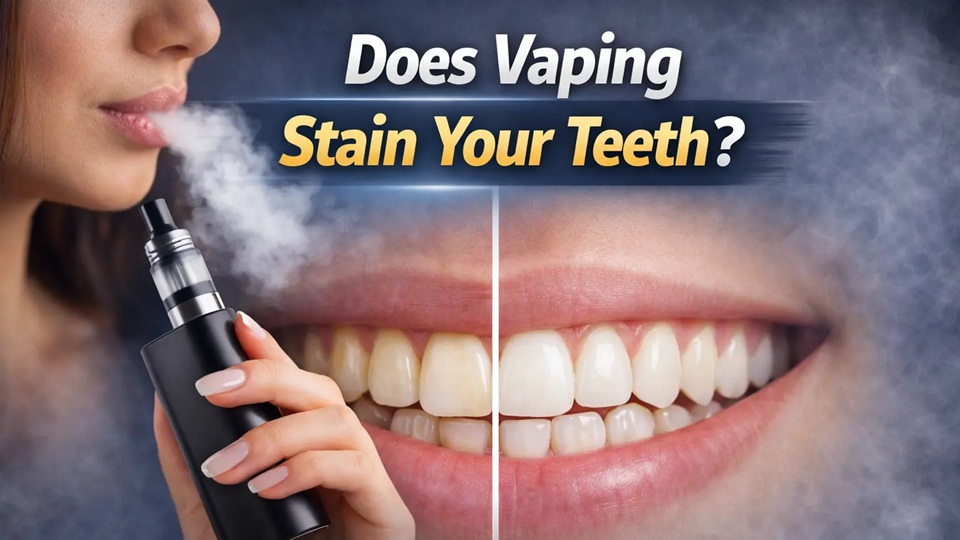
While the tar in traditional cigarettes can cause fast, dark stains on teeth, vaping doesn't have the same tar effect as classic cigarettes. But that doesn't mean your teeth are in the clear. Nicotine, aerosol residue, high heat, and dry mouth linked to e-cigarette use can increase plaque buildup over time and lead to noticeable changes in tooth color. In other words, e-cigarettes aren't as harmless as they're often made out to be—and the marks they leave on your teeth can still stick around.
Why vaping can change tooth color?
Tar in cigarette smoke is naturally dark, and it clings easily to tooth surfaces, causing heavy staining. Even though vaping doesn't contain tar, most e-cigarette liquids do contain nicotine. Nicotine starts out colorless, but when it comes into contact with oxygen, it can turn yellowish and contribute to surface staining. That's why, in many cases, vaping-related staining tends to be milder and develops more slowly than staining from traditional smoking.
The aerosol residue in e-cigarettes can stain teeth.
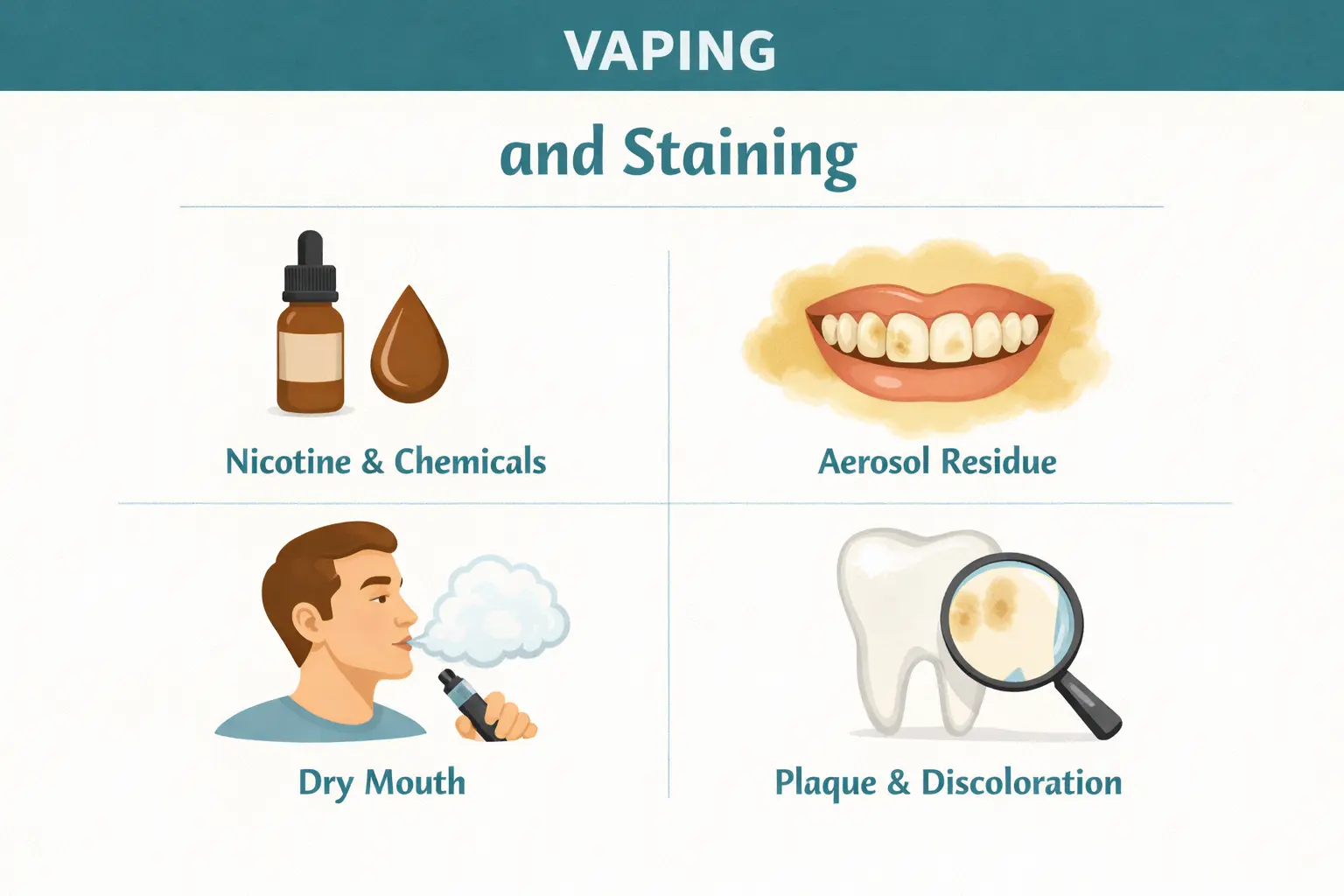
Electronic cigarettes heat liquid to create an aerosol, so what you're inhaling isn't harmless “water vapor.” It's been suggested that aerosols produced at higher heat settings can become more yellow and stickier. That can make residue more likely to hang around on tooth surfaces and set the stage for discoloration.
There's also lab data that supports this idea. In a 2025 in vitro study published in Odontology, researchers observed color changes in enamel and dentin samples that were exposed to e-cigarette vapor.
Vaping sweet flavours may also exacerbate the issue.
Sweet flavours used in e-liquids can also make the situation worse. Flavored e-liquids don't just change the experience—they can affect oral health, too. In a 2018 experimental study published in PLOS ONE, certain sweet-flavored e-liquid aerosols were shown to increase bacterial adhesion and biofilm formation on enamel surfaces. The same study also reported findings linked to a decrease in enamel hardness. [1]
Researchers note that some parts of this effect may share similar physicochemical traits with gelatin-based candies and acidic drinks. This shouldn't be taken as a direct “it stains your teeth” conclusion, but it may indirectly raise staining risk through more plaque, a rougher surface, and weaker enamel.
Dry mouth and plaque: how staining gets easier
Dry mouth—also known as xerostomia—is one of the most common side effects associated with vaping. Saliva is one of the body's natural defenses, helping clean the mouth. When saliva decreases, the mouth can't rinse itself as effectively; plaque builds up more easily, bacterial balance can shift, and tooth surfaces can turn into an easier target for staining. On top of that, a dry mouth can also open the door to other issues like cavities, gum problems, and sensitivity.
A 2023 systematic review and meta-analysis reported dry mouth prevalence in e-cigarette users at around 33%. The same rate was about 24% in people who use combustible tobacco. [7] In other words, dry mouth is pretty common among vaping users.
Reduced saliva flow can also mean lower buffering capacity and a more acidic oral environment. All of these changes may increase cavity risk and make it easier for stains to settle onto tooth surfaces.
What studies are saying so far?
A lot of scientific research has looked at how e-cigarettes affect teeth. Most of these studies are fairly recent, and many point toward clear negative effects. Here are a few examples.
In a 2019 in vitro study published in the Journal of Esthetic and Restorative Dentistry, enamel samples exposed to e-cigarette aerosols with different flavorings and nicotine levels showed measurable changes in color parameters. The study also reported that certain flavored e-liquids could increase color change and reduce surface gloss. [2]
A 2023 systematic review and meta-analysis emphasized that vaping and heated tobacco products may also cause staining in dental hard tissues and some restorative materials. At the same time, it highlighted that current evidence is limited—and that staining tends to be lower overall compared to traditional cigarettes. [3]
In a 2024 cross-sectional human study, current smokers were shown to have worse tooth whiteness index values, while former smokers who used vaping or heated tobacco products had better values. [4] That result should not be read as “vaping whitens teeth.” A more accurate takeaway is this: when someone quits smoking and switches to vaping, heavy tar-based stains may decrease, so teeth can look better compared to smoking. Still, that doesn't mean vaping has no effect on teeth.
Bottom line: can vaping stain your teeth?
The short answer: yes, vaping can stain your teeth.
The risk goes up especially when these factors come together:
- The presence of nicotine
- Stickier aerosol formed at higher heat
- Dry mouth
- Increased plaque buildup
- Using sweet or flavored e-liquids
That said, the current scientific data shows that traditional cigarettes usually cause much heavier and more obvious staining. With vaping, staining is generally milder, slower, and more variable from person to person. One big reason is how different vaping products and habits can be—device type, heat setting, liquid ingredients, flavor, and how often someone uses it can all affect the outcome.
How can you reduce staining?
For tooth color and overall oral health, the most effective approach is to quit nicotine and tobacco products entirely, if possible. The American Dental Association also states that vaping is not a risk-free alternative for the mouth and may increase the risk of tooth decay and gum disease.
If you do vape, these steps may help reduce staining risk:
- Avoid high heat settings
- Drink enough water throughout the day
- If you have dry mouth, discuss it with your dentist
- Don't skip your brushing and flossing routine
- Keep up with regular dental checkups and professional cleanings
For surface stains, professional scaling and polishing can often help. But if there's enamel wear, early-stage decay, or another underlying issue behind the color change, whitening alone may not be enough. That's why the best move is to start with a clinical evaluation.
Final word
Vaping may not stain teeth as quickly or as darkly as traditional cigarettes do. But that doesn't mean they're completely safe for your teeth. When nicotine, aerosol residue, dry mouth, and increased plaque come together, you can still see yellowing, color changes, and surface staining over time.
So, it's not accurate to say, “vaping never stains teeth.” A better way to put it is: vaping may stain less than smoking—but it can still negatively affect tooth color and oral health.
Sources
- Shin Ae Kim, Samuel Smith, Carlos Beauchamp, Yang Song, Martin Chiang, Anthony Giuseppetti,
Stanislav Frukhtbeyn, Ian Shaffer, Joshua Wilhide, Denis Routkevitch, John M. Ondov, Jeffrey
J. Kim. Published: September 7, 2018.
doi:10.1371/journal.pone.0203717
https://doi.org/10.1371/journal.pone.0203717 - The effect of electronic cigarettes on dental enamel color — Karen
Pintado-Palomino, Cecilia Vilela Vasconcelos Barros de Almeida, Christiano Oliveira-Santos,
Fernanda Panzeri Pires-de-Souza, Camila Tirapelli. First published: 27 October 2018.
doi:10.1111/jerd.12436
https://doi.org/10.1111/jerd.12436 - Effect of tobacco and nicotine in causing staining of dental hard tissues and dental materials: A systematic review and meta-analysis — Rijula R. Karanjkar (Lead / Corresponding author), Philip M. Preshaw, Janice S. Ellis, Richard Holliday.
Shipra Gupta, Vaibhav Sahni, Rosalia Emma, Stefan Gospodaru, Gheorghe Bordeniuc, Valeriu Fala,
Amaliya Amaliya, Giusy Rita Maria La Rosa, Sebastiano Antonio Pacino, Salvatore Urso, Hasan
Guney Yilmaz, Giovanni Zucchelli, Riccardo Polosa. E-cigarettes and heated tobacco products
impact on dental color parameters. Heliyon.
doi:10.1016/j.heliyon.2024.e24084
https://www.sciencedirect.com/science/article/pii/S2405844024001154

Dt. Dilek Aksu Güler
Cosmetic Dentist, Dental Implant Specialist
Dt. Dilek Aksu Güler specializes in implantology, digital smile design and cosmetic dentistry. She is the founding dentist of Antlara Dental Oral and Dental Health Clinic.