
Katie Price's smile has changed at least four times since 1997, and her name is now attached to the phrase Turkey teeth. That phrase describes a look, not a country: very white, very square, very uniform teeth that sit too far forward. It comes from over-preparing healthy teeth for crowns, and it can happen in any country, including the UK.
We are a dental clinic in Antalya, so we have an obvious interest here. That is exactly why this page is direct about what goes wrong. Pretending the problem does not exist would be less useful to you than explaining what causes it and how to check before you commit.
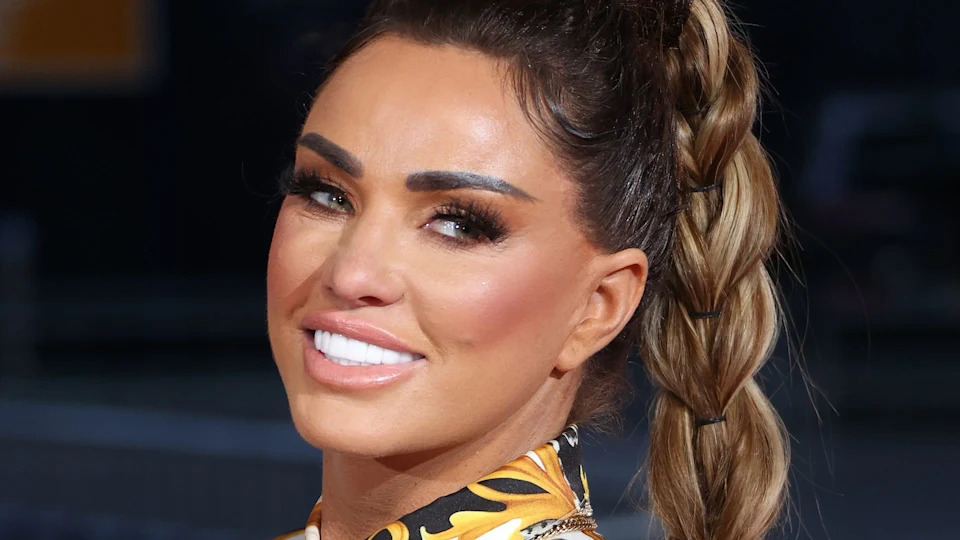
The phrase "Katie Price Teeth" instantly evokes memories of her dramatic dental transformations and iconic smile, which have become almost as famous as the star herself. Over four pivotal years between 1997 and 2019, these changes left a significant mark on her career, shaping public perception and media narratives. Throughout this journey, Katie made a series of choices, some successful, others less so. Let's delve into the advantages and drawbacks of each decision along the way.
Katie Price Teeth Before and After: The Four Transformations
Katie Price's teeth have been rebuilt four separate times, in 1997, 2007, 2017 and 2019, and the before and after comparison people search for is really a comparison across all four. Looked at together they tell a clearer story than any single pair of photographs.
The first change was orthodontic and conservative. Each one after that removed more natural tooth structure than the last, and the 2019 work abroad is the point most dentists would flag. What follows is each stage in turn, what was done, and whether it was the right call at the time.
Katie Price Teeth Transformation in 1997

Beginning her career as a model in 1996, Katie Price was a regular on the illustrious third page of The Sun. Curiously, Katie hardly ever smiled in the photos she took in 1996 and 1997. Among Katie's old student photos was the one that held the secret. The photo shows Katie's teeth clearly, which is why she was unhappy with them and hid her smile when she first started her career.
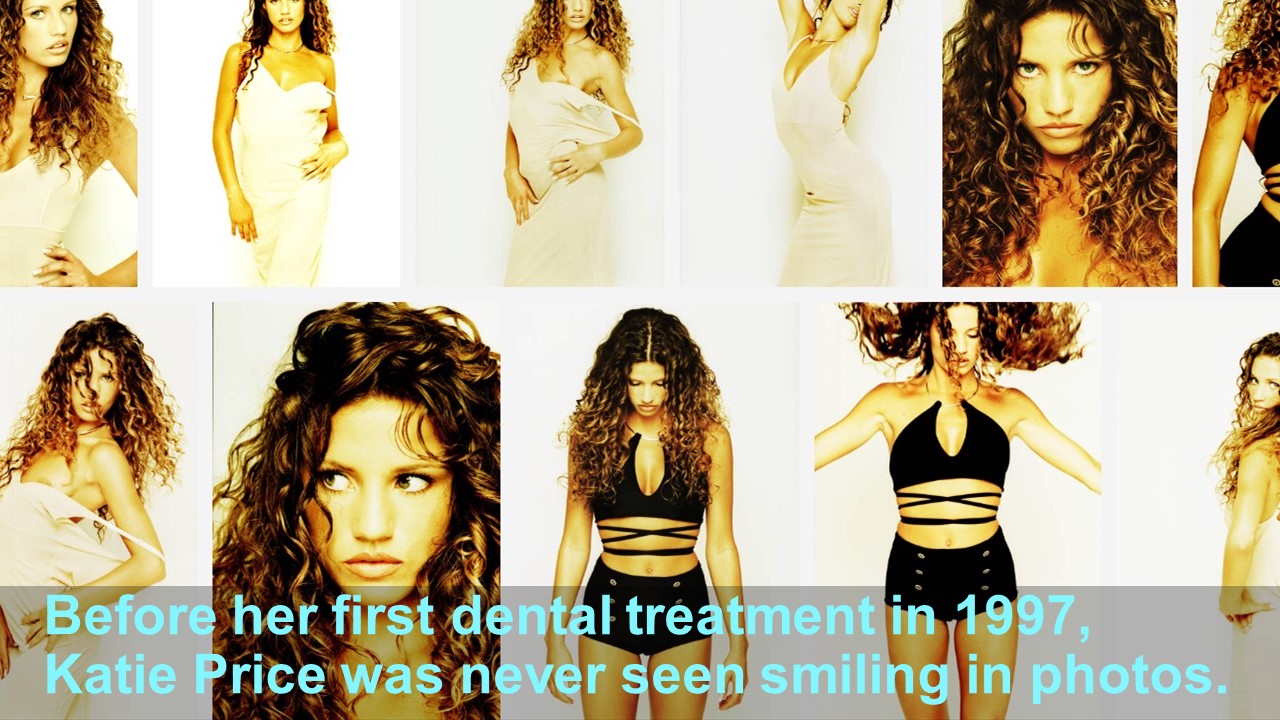
In 1998, Katie Price's teeth and smile appeared to have undergone an outstanding transformation. We saw a totally different Katie in the pictures where she posed with Michael Schumacher in May 1998. She had significantly improved the separation between her front teeth and lost the "Gummy Smile," a smile where the upper gums were overly noticeable. Katie had reached new heights with her flawless Hollywood smile, which featured long front teeth and shorter back teeth. She had gone from being just a pretty face to a famous celebrity with a timeless grin.
Was KatiePrice's 1997 Dental Transformation Right?
Despite her youth, Katie applied for restorative dental treatment when she was just 20 years old. Beside that, Katie made a pivotal decision that would shape her career in 1998 when she decided to undergo a dental transformation.
At this age, we quite often refrain from recommending such treatments and usually turn down requests. Nevertheless, the dental procedure that Katie underwent at a young age greatly propelled her career. This change seems to have favoured porcelain veneers, which only necessitate a small amount of enamel removal (0.3 mm). Taking all these factors into account, we can safely say that Katie's dental treatment in 1997 was the right decision.
Katie Price Teeth Transformation in 2007
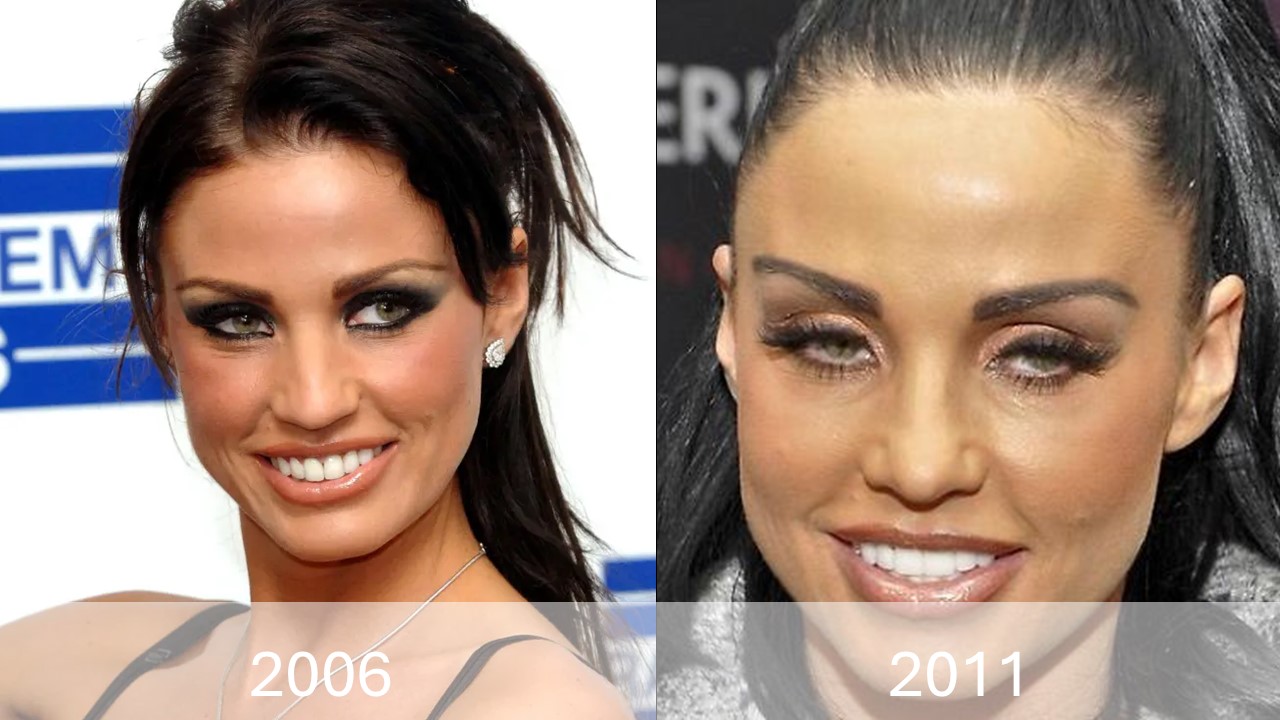
According to Daily Mail writer Charlotte Dean, Katie Price renewed her dental veneers in Spain in 2007, paying £ 25,000. By comparing photographs taken in 2006 and 2008, it is evident that the change is highly significant. Katie's new zirconium veneers expertly addressed the gap between her front teeth that could not be resolved in her previous treatment. Additionally, her front teeth were subtly shortened, resulting in a timeless Hollywood Smile with enhanced aesthetics.
Was Katie Price's 2007 Dental Transformation Right?
It is clear from Katie's 2006 pictures that she did not require a complete makeover of her teeth. However, even if porcelain veneers do not fall off after ten years of use, microscopic cracks can form, resulting in tooth discoloration over time. Here, Katie's cosmetic dentists may have recommended zirconia veneers over porcelain because of their durability. Even though it was not necessary, we think it was the right decision since her teeth would look much better with zirconia veneers placed in 2007 and she would have to get new ones soon.
Katie Price Teeth Transformation in 2017

Photos of Katie Price from 2016 demonstrate that there was no necessity for any modifications to her teeth. On the other hand, 2016 was a year that she did not smile in. So, there might be a problem with her teeth that can't be seen in pics. Also, she mentioned that an infection she had in 2015 made her gums irritated, which could be why she got treatment for that.
Upon examining Katie's images from 2017 onwards, it becomes evident that her teeth have experienced a notable shift in colour and, furthermore, her front teeth have been intentionally adjusted to protrude at a greater angle. This suggests that the dental transformation in 2017 was purely aesthetic. Katie appears to have undergone this transformation in order to attain a flawless aesthetic, despite the absence of any issues with her teeth.
Was Katie Price's 2017 Dental Transformation Right?
Katie's choice to replace her zirconia veneers with new ones in 2017, solely for cosmetic purposes, was not a prudent decision for someone at the later stages of their professional journey. It is an unwise decision because zirconia veneers are the thickest type of veneers and necessitate the removal of 0.7 to 1mm of tooth enamel through scraping.
Although this quantity of scraping does not result in any issues in the front of the teeth, it may cause irritation of the dentin area by surpassing the thinning enamel layer as it descends towards the roots of the teeth. This can hasten the decay of teeth.
Furthermore, upon examining Katie's natural teeth in 1996, it is evident that she possesses relatively small teeth. This suggests that the thickness of Katie's enamel layer may be below average, making it potentially insufficient to withstand extensive restorative procedures.
Katie Price Teeth Transformation in 2019
Katie Price released her therapy session on her YouTube channel in 2019. Katie mentioned in the video that she experienced issues with two of her molars and the loss of one after getting veneers.
Katie Price's trip to Turkey in 2019 was solely for the purpose of fixing three teeth. Nevertheless, her teeth, which had undergone ongoing restorative procedures throughout the years, had developed excessive sensitivity, rendering them unsuitable for veneers. Therefore, in order to prevent decay and tooth loss, it became inevitable to remove the veneers, which had been applied only two years earlier, and replace them with crowns.
Was Katie Price's 2019 Dental Transformation Right?
Kati Price's crown treatment in 2019 garnered significant attention from the global media and faced substantial backlash. Nevertheless, these criticisms were unreliable and did not offer a comprehensive evaluation, as they neglected the restorative treatments that Katie had previously received.
The reality is that Katie's crown treatment in 2019 was likely unavoidable. In 2017, the clinic attempted to preserve Katie's natural teeth by using veneers instead of crowns for treatment. However, two years later, they had to replace these veneers with crowns. So, it seems like the decision was the right one.
What the Phrase Turkey Teeth Actually Means
The phrase became common in the UK around 2021, mostly through reality television and social media. It does not describe a treatment. It describes an outcome: a row of teeth that look obviously artificial, usually because they are too white, too square, all the same length and too prominent.
The dental reality behind it is simpler than the headlines. In almost every case the patient received crowns rather than veneers, and did not know there was a difference. A veneer covers the front surface and removes a small amount of enamel. A crown surrounds the whole tooth, and to fit one the tooth is reduced substantially on every side.
Once that reduction is done it cannot be undone. That is the part patients are rarely told clearly enough, and it is the difference between a cosmetic choice and a permanent commitment. Our crowns vs veneers page sets the two side by side.
What Actually Goes Wrong
Four things produce the look, and none of them are specific to Turkey.
- Crowns fitted where veneers would do. Crowns are faster and more forgiving for the clinic, because they hide alignment problems that would otherwise need orthodontics first. They also destroy far more tooth.
- Skipping the orthodontic stage. If teeth are crowded, the correct sequence is to straighten them and then restore them. Covering crowded teeth with crowns is quicker but pushes the new teeth forward, which is where the prominent look comes from.
- A shade chosen too bright. BL1 and BL2 are brighter than anything natural. Combined with uniform square shapes, the result reads as false from across a room. Our tooth shade guide explains how shades are picked.
- Too many teeth treated. Twenty or more units when eight would have done. Every additional crown is another healthy tooth reduced.
The common thread is speed. A full arch of crowns can be delivered in a week. Straightening first, then restoring, takes months. When a treatment plan is built around a holiday length rather than around the mouth, this is the result.
How to Avoid It
- Ask whether you are being offered crowns or veneers, and why. If the answer is vague, that is your answer. The word "veneer" is sometimes used loosely for both.
- Ask how much tooth will be removed. A clinic should be able to tell you plainly, and show you on a model or a scan.
- Ask whether you need orthodontics first. If your teeth are crowded and nobody mentions straightening, ask why not.
- Question the number of units. Ask why that many teeth need treating, and what happens if you treat fewer.
- Look at the shade in daylight. Not under surgery lights, and not on a screen.
- Ask what happens in five years. Crowns need replacing eventually, and the tooth underneath cannot be restored to its original state. Know that before, not after.
None of this is about avoiding treatment abroad. It is about avoiding a plan built around a timetable. If you want the wider picture, our Turkey teeth guide covers the checks in detail, and Turkey teeth gone wrong looks at cases that did not work out.
Conclusion
Katie Price's journey with cosmetic dentistry offers valuable insights for anyone considering similar treatments. Her experiences, both good and bad, have shaped her career in significant ways. But if you're not a public figure like Katie, it's crucial to carefully evaluate the longevity and potential challenges of any cosmetic procedure, ensuring it's the right fit for you.
At Antlara Dental, we're dedicated to helping you achieve the stunning smile you desire, just like Katie's. Our expert cosmetic dentists, each with 20 to 30 years of experience, have been proudly serving our European clients since 2005. As we always say, "Go the extra mile, for your smile."
Note: The information presented in this article about Katie Price's personal life and dental health is sourced from publicly available news outlets and open-source platforms. While we strive to provide accurate and up-to-date information, some details may be speculative or not definitively confirmed. This article is intended for informational purposes only and does not claim to present factual or authoritative statements. Readers are encouraged to consult official statements or verified sources for the most accurate information.
Other celebrity smiles we have looked at in the same way: Miley Cyrus and the Stranger Things cast.
Katie Price Teeth and Turkey Teeth: FAQ
The questions people search for most on this subject.
Her smile has changed several times since 1997, moving from her natural teeth to progressively whiter, more uniform restorations. She has spoken publicly about having dental work abroad on more than one occasion. The exact treatments at each stage have not been detailed by her dental teams, so descriptions of the specific procedures are informed observation rather than confirmed fact.
She has spoken publicly about travelling abroad for dental treatment, and her name is frequently linked with the phrase Turkey teeth in UK media. That association is part of why the phrase spread. What matters more than where the work was done is what was done: crowns on prepared teeth produce this look regardless of which country the clinic is in.
Dentists commenting on photographs generally describe crowns rather than veneers, because of the shape, the uniformity and how far forward the teeth sit. Crowns require the tooth to be reduced on all sides, while veneers only cover the front. Neither she nor her dental team has publicly confirmed which was used, so this remains professional interpretation.
It is a UK slang phrase, not a dental term. It describes teeth that look obviously artificial: very white, very square, all one length and sitting too prominently. It usually results from fitting crowns to healthy teeth without straightening them first, and from choosing a shade brighter than anything natural. The same result occurs in clinics anywhere, including in Britain.
Two reasons combine. The shade is often chosen from the bleached guide, which is brighter than natural enamel, and the teeth are usually crowns rather than veneers. A crown has to be thick enough to be strong, so if the underlying tooth was not reduced enough, or was crowded to begin with, the finished tooth ends up bulkier and further forward than the original.
No, and the phrase is misleading on that point. Turkey has well regulated clinics, highly experienced dentists and a large dental tourism sector, alongside operations that sell full arches of crowns as a holiday package. The variable is the clinic and the treatment plan, not the country. The same range of quality exists in the UK at three to five times the price.
Partly. Crowns can be replaced with better shaped and better shaded ones, and gum health can usually be improved. What cannot be recovered is the tooth structure that was removed to fit the original crowns, so those teeth will always need to be covered. If nerves were damaged, root canal treatment may be needed before anything cosmetic is done.
A full smile makeover of 20 units with gum aesthetics is around EUR 5,000 in Antalya, against roughly GBP 15,000 in the UK. Individual laminate veneers run about GBP 200 to GBP 300 per tooth here compared with GBP 600 to GBP 1,000 in Britain. The important question is not the price but how many units you actually need.
Ask whether you are getting crowns or veneers and how much tooth will be removed. Ask whether orthodontics should come first if your teeth are crowded. Question why a particular number of teeth needs treating. Choose the shade in daylight. If a clinic will not answer these plainly, or builds the plan around your flight dates, look elsewhere.