
Choosing veneers comes down to three separate decisions, and most people only realise this once they are in the chair. You choose a material, you choose a shape, and you choose a shade. They are decided in that order, because each one narrows what is possible in the next.
Material decides how the veneer behaves: how thin it can be, how much of your own tooth has to be removed, how it handles biting force, and how it ages. Shape decides whether the result looks like your face or like somebody else's. Shade decides whether it reads as teeth or as a bathroom tile.
This guide covers all three, and it also covers the part most veneer pages leave out: the cases where veneers are the wrong treatment and something else serves you better.
As a part of cosmetic dentistry, veneers come in a wide variety of properties and materials. Discoloured or stained teeth, crooked teeth, and minor fractures can all be effectively treated with them.
Veneers are also common in aesthetic dentistry when creating smile designs. Dentists may use different types of veneers for different teeth shades and structures.
Getting veneers done can be overwhelming; many factors that are associated with your decision to get dental veneers. We want you to have an in-depth knowledge of what you are looking for when you start your search.
Here is everything you need to know about which type of veneer is right for you.
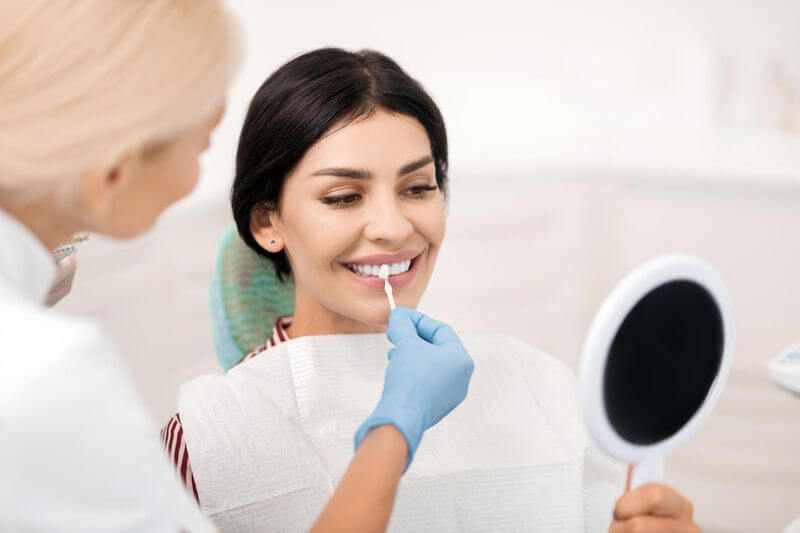
What is Dental Veneer? Who is Suitable for It?
Applied to the front surface of teeth, dental veneers are materials that cover the entire surface of the tooth. Using them in smile designs is an excellent way to achieve the desired results. Veneers enable dentists to design teeth that are slightly longer on the front teeth and shorter on the back teeth.
Each type of veneer involves a different amount of scraping of the tooth surface, but the amount is generally quite small. It can thus be applied without causing too much abrasion to the teeth.
The majority of veneers are used for aesthetic purposes in the anterior region, but they are also used to close cavities after treatment.
Different types of veneers may be preferred in different regions. A laminate veneer is the best type of teeth veneer for the anterior region, whereas porcelain fused to metal veneers (PFM) or zirconia veneers are better for the posterior areas.
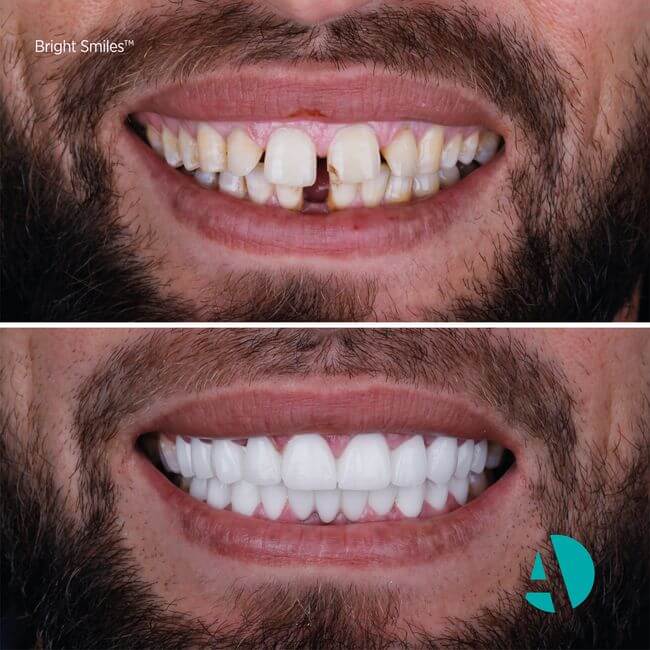
Types of Veneers
Every veneer has different properties as a result of the different production techniques used to produce them. The areas of use also differ based on these features. Listed below is detailed information on types of veneers.
1. Porcelain Veneers
Porcelain is generally thought of as the best veneer material. Although it has a hard and brittle structure, it has high light transmittance and is quite aesthetically pleasing. There are so many different types of porcelain veneers, but we can generally group them into a few categories.
a. Laminate Veneers
Laminate veneers are one of the most preferred materials in the field of aesthetic dentistry. Their application involves very little tooth abrasion (0.1-0.3 mm). Typically, they last between 10 and 12 years. As they do not damage the tooth structure, their change does not pose any problems.
b. Empress Veneers
Empress veneers are obtained by chemically processing porcelain veneers and coating them with glass ceramics. With their thin structures, they provide the desired aesthetic and natural appearance. They have an average resistance force of 150Mpa.
c. E-Max Veneers
Emax veneers are a type of Empress veneers. This is the name given to them by the manufacturer. They are produced using lithium disilicate. 0.3-0.7 mm of abrasion from the tooth surface is required to adhere to the tooth.
Their thin and light transmittance structure allows the same results as laminate veneers. Their resistance force is 420 MPa. With Zirconium reinforcement, Emax offers up to 500 MPa resistance.
d. Zirconia Veneers
Zirconia is a kind of porcelain veneer obtained from zirconium. They can provide resistance up to 1100 Mpa. Additionally, they are softer than porcelain veneers and have very high biocompatibility.
On average, they last 20% longer than all-porcelain veneers. Due to its high opacity values, zirconia veneer cannot achieve the natural look of laminate and E-Max veneers.
Zirconia veneers are more suitable for posterior teeth because of their robust structure. In zirconia veneer, teeth must be abraded around the entire edge of the tooth, whereas laminate veneers only require abrasion on the anterior surface.
The amount of abrasion in zirconia veneer, which is around 0,7-1mm, is also higher than the laminate veneers.
2. Porcelain Fused to Metal Veneers
PFM veneers are made by coating porcelain with metal. They are long-lasting veneers that are about 20 years or more. Since porcelain's metal content causes grey color formation on the gums and allergies, its use has decreased in recent years.
3. Composite Veneers
Composite veneers are made with bonding material that is used to bond veneers. It is applied to the tooth without abrasion. They have an effective lifetime of 5-7 years. Since they do not damage the tooth structure, they can be easily renewed.
4. Metal Veneer
The metal veneers are very thin and solid veneers that can last up to 30 years. However, they are not preferred because of their colours.
Veneer Materials Compared
The material is the decision with the longest consequences, because it determines how much natural tooth is removed. That part is irreversible.
| Type | Tooth removal | Best suited to |
|---|---|---|
| Porcelain | Moderate | The general purpose choice for front teeth, good colour stability |
| E-max (lithium disilicate) | Minimal to moderate | Front teeth where translucency matters most |
| Zirconia | Moderate | Cases needing more strength, or where a dark tooth must be masked |
| Laminate (thin porcelain) | Minimal | Small corrections on teeth that are otherwise sound |
| Composite | Little to none | Reversible changes, chips, and trying a shape before committing |
| Metal backed (PFM) | More | Largely superseded for front teeth by all ceramic options |
Two points worth holding on to. First, less tooth removal is generally better, because enamel does not regenerate and a prepared tooth stays prepared for life. Second, composite is the only option on that list that is genuinely reversible, which makes it useful when you are unsure.
We cover the individual materials in more depth on their own pages: E-max veneers, zirconium porcelain veneers, laminate veneers and composite bonding.
Veneers or crowns?
A veneer covers the front surface of a tooth. A crown covers the whole tooth. If the tooth is largely intact and the issue is appearance, a veneer is usually the more conservative answer. If the tooth is heavily filled, cracked or root treated, a crown is the sounder choice because it protects what remains. We set the two side by side in our guide to crowns versus veneers.
All Shapes of Veneers
Veneers can be designed in the desired shape and size for each tooth. Because of this, there are hundreds or even thousands of different shapes of veneers, but 12 standard veneer shapes have been established so that you can easily choose veneers for your teeth.
1. Aggressive
This method gives the central incisors and lateral teeth a square appearance while the canines are slightly curved. It is more common for men to employ this method, which reflects a more powerful personality.
2. Dominant
Central incisors have a rounded square appearance, and the corners of the lateral teeth are rounded. The canine teeth are sharply prominent. The lateral incisors are slightly longer than the central incisors.
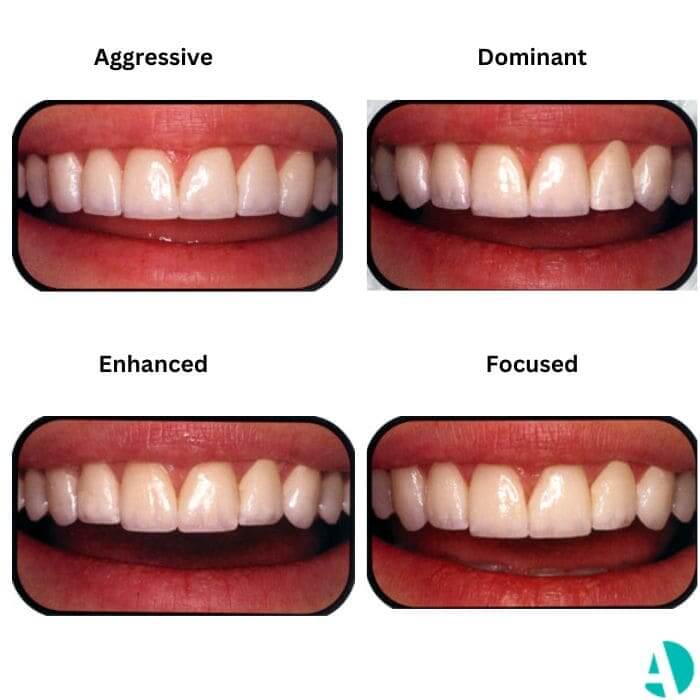
3. Enhanced
In this smile style, the edges of the central and lateral teeth are slightly rounded. The canines are indicated pointedly. As the teeth go backward, they become more visible, thanks to the design. This is why women choose it for beauty contests or to emphasize their white teeth.
4. Focused
This model is very similar to the enhanced model, but in this model, the edges of the central incisors are not rounded; they are square.
5. Functional
This model is designed like the enhanced model, except that the canines are emphasized more. They are slightly longer than the central incisors.
6. Hollywood
In the Hollywood smile design, the central incisors are slightly longer than the other teeth, the teeth get shorter as you go back, and the tips of the front teeth are visible when the mouth is free.
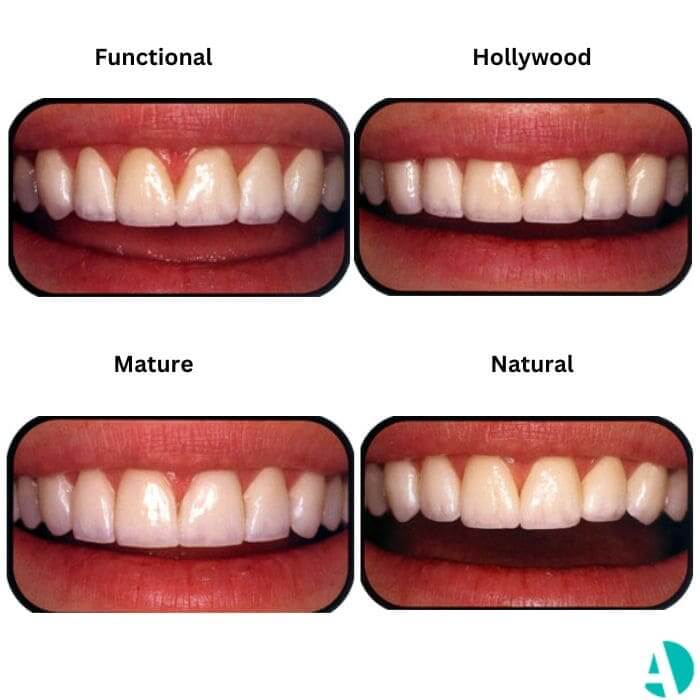
7. Mature
Like the aggressive design, but with a more prominent canine tooth.
8. Natural
Like the enhanced design, but with more prominent canines.
9. Oval
In this method, the teeth are rounded more, creating a more oval appearance than in the aggressive style.
10. Softened
Oval designs are less highlighted in this method and are more noticeable for the posterior teeth.
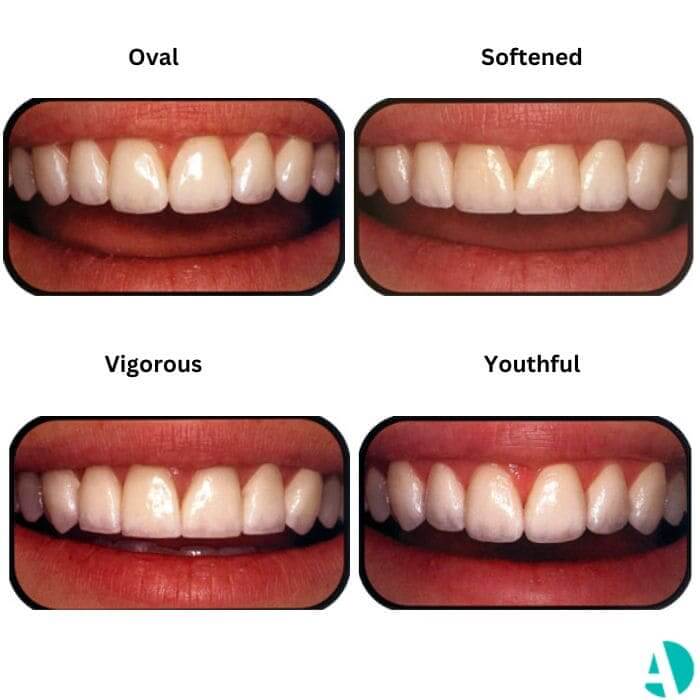
11. Vigorous
Like the aggressive style, the central incisors are square and flat, but the canines are prominent.
12. Youthful
It has a similar structure with an oval design. However, the canines are more prominent and protruding, as in the vigorous style.
Colours of Veneers
Veneer colours are determined by the colour of your natural teeth and skin colour. Dentists generally prefer two shades of lighter colours to provide the desired result better.
Veneers color chart usually consists of 4 categories, and each category has 11 different colour options. In the veneer teeth color chart, the categories are reddish-brown, reddish-yellow, grey, and reddish-grey.
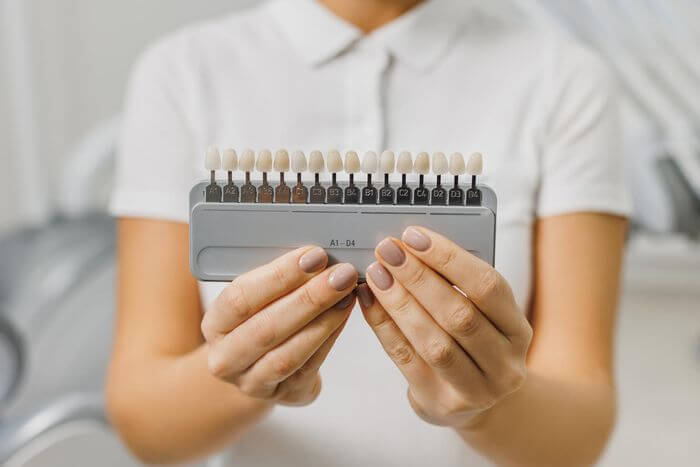
What Color Veneers Should I Get?
In this decision made jointly with the aesthetic dentist, try to convey your expectations to your dentist as clearly and precisely as possible.
Dentists will recommend lighter tooth tones for someone who is constantly in front of the camera, while they will recommend grey tones for more formal work. In general, there are 5 main elements in determining the color of veneers.
- The natural colour of your teeth
- Your skin colour
- Your gender
- Your age
- Your profession
Choosing the Shade
Shade is where most regret is concentrated, and it is the easiest of the three decisions to get wrong, because a shade that looks right under surgery lighting can look very different in daylight.
Two rules help. First, judge the shade against your own face, not against a shade guide held in mid air. Skin tone, lip colour and the whites of the eyes are the reference points people actually notice. Second, the whitest available shade is rarely the most flattering one, and it is the shade that ages least gracefully as the rest of the face changes.
Natural teeth are not a single flat colour either. They are more translucent at the biting edge and more saturated near the gum. A veneer that reproduces that gradient reads as a tooth. One that does not reads as a veneer, whatever the shade number.
We explain the individual shade codes, including how 1M1, B1 and A1 differ and whether B1 is too white for most faces, in our tooth shade guide.
Before and After: What Actually Changes
Before and after photographs are the most searched part of this subject and the least reliable. Lighting, lip retractors and camera angle change a smile as much as the dentistry does. It helps to know what veneers genuinely alter.
What changes: the colour of the visible surface, the shape and length of each tooth, small gaps, worn or chipped edges, and the line the teeth make against the lower lip.
What does not change: the position of the roots, how the teeth meet when you bite, the health of the gums, and the shape of your face. A veneer is a facing, not orthodontics and not surgery.
The most common disappointment we see is not poor workmanship. It is a patient who wanted straighter teeth and received whiter ones. Be specific about which of the two matters more to you, because they are different treatments.
How many veneers do people usually have?
It depends entirely on how wide your smile is when you smile fully. Some people show six upper teeth, others show ten or twelve. There is no standard number, and a clinic quoting a fixed count before seeing your smile line is guessing. The aim is that treated and untreated teeth are never visible side by side in the same view.
When Veneers Are the Wrong Answer
This is the section we would want a member of our own family to read first.
- If colour is the only complaint. Whitening changes shade without touching the tooth surface. Removing enamel to fix a colour problem is a heavy solution to a light problem.
- If the teeth are significantly crooked. Veneers cover the front, they do not move anything. Covering crowded teeth pushes them forward and the result looks bulky. Aligners or braces first, then restore only what still needs restoring.
- If you grind your teeth. Grinding cracks porcelain. The grinding is treated first, and a night guard is part of the plan afterwards either way.
- If the gums are not healthy. Veneers sit at the gumline, so inflamed or receding gums need treating before anything is bonded.
- If you want it reversed later. Prepared teeth cannot be returned to their original state. If you are unsure, composite is the way to test a shape.
A clinic that recommends veneers without examining you, or without raising any of the above, is selling rather than diagnosing.
What Are the Benefits of Veneers?
Once considered to be an expensive cosmetic dental treatment available only to Hollywood stars, veneers now offer both aesthetic and functional benefits.
- Inpidual designs and colour options can be tailored to each person's facial structure and style.
- In addition to improving the sense of confidence, it prevents people from feeling inferior because of their teeth.
- They cannot cause major damage to the tooth structure.
- They can be renewed after the end of their functional life.
- Patients using veneers give more importance to their oral and dental health.
When it comes to dental veneers, you want the most natural bright, and healthy smile. The good news is now, you have all the necessary information you need when choosing which one is best for you.
Veneers: Common Questions
The questions patients ask us most often before choosing veneers.
Porcelain, E-max lithium disilicate, zirconia, thin laminate porcelain, composite, and older metal backed versions. They differ mainly in how much natural tooth has to be removed and how they handle biting force. Composite needs the least preparation and is the only genuinely reversible option, while all ceramic types give better colour stability over time. The right one depends on the tooth, not on a ranking.
Composite usually needs little or no preparation at all, which is why it is often used to test a shape before committing to anything permanent. Among the ceramics, thin laminate veneers need the least, followed by E-max. Older metal backed veneers need the most. This matters because enamel does not grow back, so a tooth that has been prepared stays prepared for the rest of your life.
Shape is chosen against your face rather than from a catalogue. The width of your smile, how much of the upper teeth your lip reveals, the shape of the face and the proportions between the front teeth all feed into it. The twelve named shapes are a shared vocabulary between dentist and laboratory, not a menu. A good result usually looks like a tidier version of your own teeth.
A shade close to the whites of your eyes generally reads as natural, and it stays flattering as the face ages. The brightest available shades photograph well but tend to look artificial in daylight. Natural teeth are also not one flat colour, being more translucent at the edge and more saturated near the gum, so a veneer that copies that gradient looks convincing regardless of the number on the shade guide.
Not really. A veneer covers the front surface of a tooth, it does not move the root. Mild irregularity can be disguised, but covering genuinely crowded teeth pushes them forward and the result looks bulky and feels unnatural. Where teeth are significantly out of line, aligners or braces come first, and veneers are then used only on the teeth that still need them.
They do not ruin a tooth, but most types do permanently change it, because a layer of enamel is removed so the veneer can sit flush. That part cannot be undone, and the tooth will need a restoration of some kind from then on. This is why the material decision matters so much, and why composite is worth considering if you want something reversible while you make up your mind.
It depends on how many teeth show when you smile fully, which varies a lot between people. Some show six upper teeth, others ten or twelve. There is no standard number, and any clinic giving you a fixed count before seeing your smile line is guessing. The goal is that treated and untreated teeth never appear next to each other in the same view.
A Hollywood smile is a treatment plan rather than a material. It usually combines veneers or crowns across the whole visible zone with shade and shape changes, and sometimes gum contouring. Veneers are one of the components used to achieve it. We describe what the full process involves on our Hollywood smile page.
No. Whitening works on natural tooth substance and has no effect on ceramic or composite. If you plan to whiten, it is done before the veneers are made, so the new work can be matched to the lighter shade. Whitening afterwards only lightens the teeth around the veneers and leaves you with a mismatch.

Dt. Dilek Aksu Güler
Cosmetic Dentist, Dental Implant Specialist
Dt. Dilek Aksu Güler specializes in implantology, digital smile design and cosmetic dentistry. She is the founding dentist of Antlara Dental Oral and Dental Health Clinic.